LLM Routing Strategies: When Each Architecture Wins
Strategy follows workload traits: stable traffic with eval pipelines justifies trained classifiers; heterogeneous unlabeled workloads earn cascade; intent…
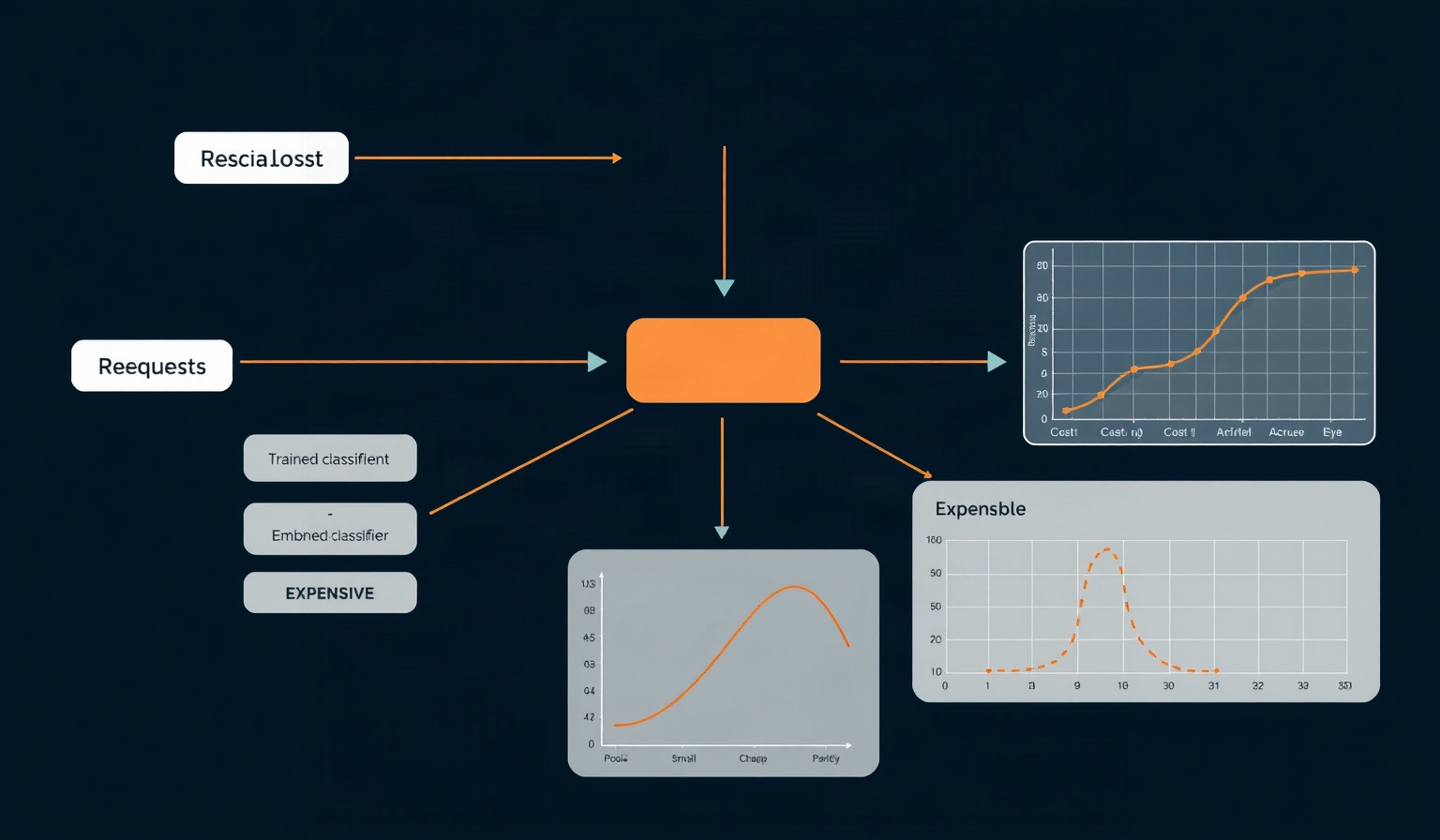
LLM Routing Strategies: When Each Architecture Wins
Sending every prompt to the same frontier model is the wasteful default of most LLM deployments — a one-size-fits-all approach that burns budget on simple queries while still bottlenecking on the hardest ones. The routing premise is that models are complementary across cost and quality dimensions, so a router can match each request to the cheapest model that still satisfies it.
How This Was Researched
This review is based on official documentation, pricing pages, and community reports — we did not run the tool hands-on. It draws on cited arXiv papers (FrugalGPT, RouteLLM, Zooter, RouterEval, LLMRouterBench), official vendor documentation from LiteLLM, Portkey, Cloudflare, NotDiamond, and OpenRouter, and vendor engineering content. Sources span January–August 2026 for currency.
What a Router Actually Decides
A router makes four distinct decisions: which model to call, which provider hosts it, how to load-balance across replicas, and when to fail over. OpenRouter frames this as a two-layer split — provider selection (cost, latency, uptime) and model selection (quality fit for the prompt) — which keeps infrastructure concerns separate from quality routing Source: OpenRouter. A router is a per-request decision engine placed in the request path; a gateway is a unified access point that may embed routing logic but also handles auth, rate limits, and caching. Gateways from LiteLLM, Portkey, and Cloudflare serve as deployment vehicles, but the routing decision itself is model selection, not throughput management.
Cascade Routing: Escalate on Weakness
Cascade routing calls models sequentially, escalating to a stronger (and costlier) model only when the current one signals low confidence. FrugalGPT shows this can deliver up to 98% cost reduction while matching GPT-4, or a 4% accuracy gain at equal cost Source: FrugalGPT. Confidence signals include self-verification (the model judges its own answer), deterministic checks (schema validation, arithmetic), and tool-call success. The tradeoff is escalated tail latency and dependence on verification-signal quality. Cascade wins when workloads are heterogeneous and no labeled training data exists, because it needs no supervision to decide when to escalate.
Classifier-Based Routing: Learned Routers
Learned routers are trained on preference data to predict which model best satisfies a given prompt. RouteLLM trains preference-data routers that achieve over 2x cost reduction with no quality loss, and the routers transfer when models swap Source: RouteLLM. Zooter uses reward-model-guided routing and outperforms the best single model across 26 benchmarks Source: Zooter. NotDiamond lets teams train custom routers on roughly 15+ samples and retrain via API — a vendor claim Source: NotDiamond. LLMRouterBench warns that many routers fail to beat simple baselines and suffer persistent model-recall failures Source: LLMRouterBench. RouterEval finds that capable routers improve as the candidate pool grows Source: RouterEval. Learned routing wins when traffic is stable, an evaluation pipeline exists, and scale justifies MLOps overhead.
Semantic and Embedding-Based Routing
Semantic routers treat routes as labeled utterances and match incoming prompts by embedding similarity plus thresholds. Aurelio’s semantic-router supports hybrid layers and local encoders for millisecond decisions with no LLM call Source: semantic-router. Strengths are speed, determinism, and zero LLM cost per decision. Limits include a fixed route vocabulary, threshold tuning burden, and no ranking of model quality. This approach is right for intent-to-pipeline routing (e.g., “billing question → customer-service flow”) but wrong for quality-tier routing, where cost and accuracy tradeoffs matter more than intent classification.
The Tradeoffs: Cost, Latency, Accuracy
The headline numbers are concrete: cascade routing can cut costs by up to 98% or gain 4% accuracy at equal cost Source: FrugalGPT; RouteLLM routers deliver over 2x cost reduction with no quality loss Source: RouteLLM. Router-added latency is typically sub-millisecond for embedding or classifier routers, but cascade escalation adds the full latency of the stronger model. Cost ceilings matter: OpenRouter supports max_price and :floor sorting to cap spend per request Source: OpenRouter. Accuracy risk is real — LLMRouterBench documents model-recall failures where routers misroute systematically Source: LLMRouterBench. The eval-driven selection loop ties it together: measure routing loss on your data before trusting any router.
Production Patterns and Design Guidance
Routing is a maturity ladder. Step 1: deterministic tiering plus gateway failover via LiteLLM, Portkey, or Cloudflare Source: LiteLLM Source: Portkey Source: Cloudflare. Step 2: cascade on confidence for heterogeneous workloads. Step 3: semantic routing for intent classes. Step 4: a trained classifier only when you have evaluation data, traffic scale, and a measurable routing-loss metric. Traffic mirroring — available in LiteLLM — lets you shadow a new router against production traffic before cutover Source: LiteLLM. Monitor router agreement (do two routers pick the same model?) and per-tier quality to catch degradation. Managed auto-routers offer convenience but can obscure reproducibility, so pin versions where possible. For broader context on the AI stack, see /stack/ and /tools/.
Which LLM Routing Strategy Actually Cuts Inference Costs in Production?
The answer depends on workload traits, not algorithm sophistication. Stable traffic with an evaluation pipeline and scale to justify MLOps earns a trained classifier router. Heterogeneous workloads without labeled data earn cascade escalation. Intent-driven pipelines earn semantic routing. Everything else starts at deterministic tiering plus gateway failover. The 2025–2026 benchmark evidence — LLMRouterBench Source: LLMRouterBench and RouterEval Source: RouterEval — shows that many sophisticated routers fail to beat simple baselines, making architecture selection the critical engineering decision. The maturity-ladder recommendation is to start deterministic, escalate on confidence, and only train a classifier when you can measure routing loss on your own data.
FAQ
Does model routing degrade output quality?
Routing can degrade quality when the router misroutes, and LLMRouterBench documents persistent model-recall failures where routers systematically pick the wrong model Source: LLMRouterBench. However, RouteLLM shows that preference-data routers can achieve over 2x cost reduction with no quality loss when trained on the right data Source: RouteLLM. The key is measuring routing loss on your own evaluation set before deployment, not trusting aggregate benchmark claims.
How much data do I need to train a custom router?
NotDiamond claims custom routers can be trained on roughly 15+ samples and retrained via API Source: NotDiamond, but RouteLLM relies on preference data collected from human or automated judgments across model pairs Source: RouteLLM. The practical threshold is having enough labeled examples to measure routing loss reliably — which usually means hundreds of prompts with known good outcomes, not just the minimum sample count.
Should I use a managed router or build your own routing layer?
LiteLLM offers self-hosted routing with fallbacks, cooldowns, and traffic mirroring for teams that want full control Source: LiteLLM. Portkey and Cloudflare provide managed AI gateways with conditional routing and dynamic failover for teams that prefer operational simplicity Source: Portkey Source: Cloudflare. The tradeoff is control and reproducibility versus MLOps overhead — choose based on whether routing is a core differentiator or a commodity concern for your product.
Conclusion
Routing is a maturity ladder, not a silver bullet: deterministic tiering and cascade escalation solve most cost problems before a trained classifier is justified. The 2025–2026 benchmark evidence shows that sophisticated routers often fail to beat simple baselines, so architecture selection matters more than algorithm sophistication. Tie your choice to workload traits and measure routing loss on your own data — see our guide to /stack/ for the broader deployment context.
📖 Related Reads
- ToolBrain — tool reviews, LLM comparisons, and AI workflow guides
Cross-links automatically generated from CodeIntel Log.