LLM Guardrails Architecture: The Layered Defense Stack
LLM guardrails architecture assigns each check to one of six request-path layers—network/egress, gateway/proxy, input screening, model-adjacent defense,…
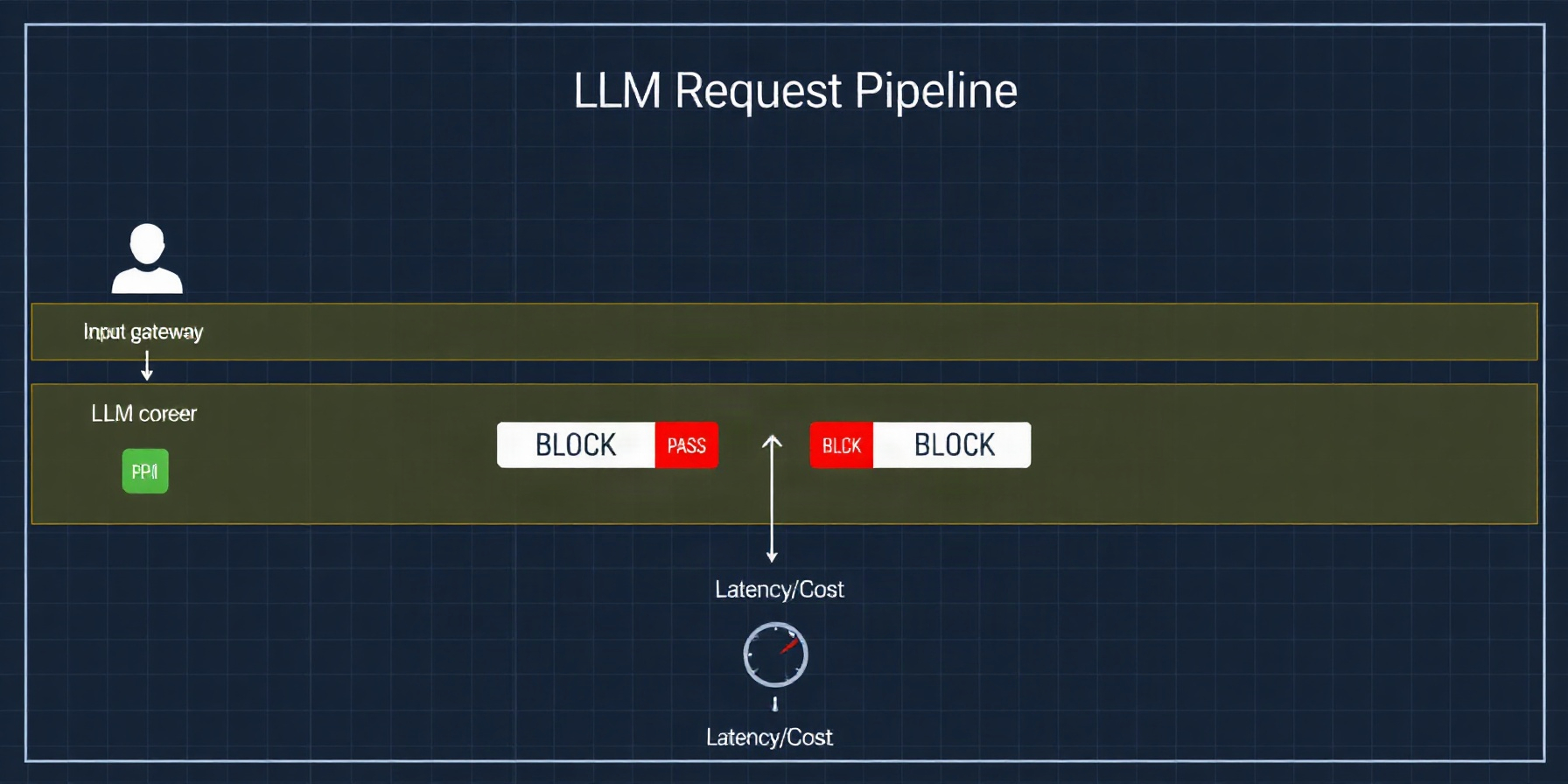
LLM guardrails architecture is the discipline of assigning every enforcement check to one of six request-path layers, knowing exactly what each layer catches and misses, and budgeting overhead per check rather than per stack. Your LLM’s refusal behavior is a probability, not a policy — a determined attacker or careless user can shift that probability with enough retries. Production enforcement of prompt-injection, PII, and tool-use policy requires a layered guardrail stack where each check lives on a specific layer and no single layer is trusted.
How This Was Researched
This analysis is documentation-based, not hands-on. We reviewed primary vendor documentation and engineering postmortems, all verified accessible in August 2026: NVIDIA NeMo Guardrails docs, OWASP LLM Top 10, Microsoft Azure AI Content Safety, OpenAI moderation guide, Anthropic’s production containment writeup, Guardrails AI validators docs, and Cloudflare AI Gateway docs. We did not cover regulatory compliance frameworks or fine-tuning-based safety; conclusions are limited to the enforcement-layer data above. Last researched: August 2026.
What Is LLM Guardrails Architecture?
A guardrail is a deterministic or model-based check that blocks, rewrites, or re-routes content around an LLM call, enforcing safety, privacy, format, and tool-permission policy as a layer separate from model training. Three enforcement modes exist: block (reject), alter (redact or mask PII), and route (reask or escalate to human review). Policy changes ship without retraining. NVIDIA’s NeMo Guardrails codifies this with five rail types — input, retrieval, dialog, execution, output — configured via YAML and Colang flows, deployable as a Python library or a Kubernetes microservice exposing an OpenAI-compatible endpoint.
The Six Layers of the Guardrail Stack
Every production check belongs to one of six request-path layers: network/egress, gateway/proxy, input screening, model-adjacent defense, output filtering, and tool-execution policy. Vendor implementations map cleanly: NeMo’s five rails span layers 3–6, Azure Prompt Shields sits at layer 3, OpenAI’s inline moderation covers layers 3 and 5, and Cloudflare AI Gateway occupies layers 1–2 with caching, rate limiting, and fallback. Defense-in-depth means no single layer is trusted to catch everything. For the surrounding production stack, see the AI stack reference.
Layers 1–2: Egress and Gateway, the Deterministic Boundary
Egress rules, sandboxes, and gateway limits are the only checks that work regardless of model behavior — the deterministic boundary that catches what probabilistic checks miss. Anthropic’s Claude Code sandbox denies network access by default, and their Cowork product routes traffic through an egress proxy; Cloudflare AI Gateway adds caching, rate limiting, retries, and model fallback with “one line of code.” Azure enforces abuse control at the gateway with an S0 quota of 1000 requests per 10 seconds for text and image APIs.
Layers 3–4: Input Screening and Model-Layer Defense
Input screening catches injection, jailbreaks, and PII before the model sees them: Azure Prompt Shields detect jailbreak and input attacks, NeMo offers heuristic, self-check, and NIM jailbreak rails, and Llama Guard classifiers — the original 7B plus Llama Guard 3’s 1B and 8B variants — flag unsafe content. Model-layer defense is probabilistic: Anthropic reports Claude Opus 4.7 holds attack success to ~0.1% on single-attempt Gray Swan injections, degrading to 5–6% after 100 adaptive attempts — never 100%.
Layers 5–6: Output Filtering and Tool-Call Policy
Output checks validate what the model returns: OpenAI’s omni-moderation-latest scores input and output inline in a single request — free, text and image, 13 harm categories — while Azure adds groundedness and protected-material detection. Tool-call enforcement validates actions pre-execution: Azure’s task-adherence API catches misaligned tool use, NeMo execution rails gate actions, and Guardrails AI validators return PassResult/FailResult with user-configured on_fail policies. Anthropic’s auto-mode classifier blocked ~0.4% of benign commands while ~17% of overeager actions slipped through.
Where Guardrail Checks Fail in Production
Anthropic’s postmortems expose each layer’s blind spot: users approved ~93% of permission prompts (approval fatigue), project config hooks executed before the trust dialog appeared, and a malicious “run this prompt” email exfiltrated ~/.aws/credentials in 24 of 25 retries — a user-as-injection-vector case where nothing anomalous existed for a classifier to catch. Egress allowlists became capability grants when data exfiltrated through the allowed api.anthropic.com endpoint. OWASP LLM Top 10 formalizes these as LLM02 Insecure Output Handling, LLM06 Sensitive Information Disclosure, and LLM08 Excessive Agency. See our production failure trace analysis for deeper incident patterns.
Measuring Guardrail Overhead: Latency and Cost Budget
Budget per check, not per stack. Inline moderation scores avoid a second round trip — OpenAI’s omni-moderation-latest returns scores within the generation request itself. Classifier size matters: Anthropic inspects tool returns with a small fast model because it “doesn’t need to be the one doing the reasoning,” which is exactly why Llama Guard 3-1B exists. Instrument p50/p99 added latency per check, tokens spent on self-check rails, and per-check false-positive and false-negative rates. Public full-stack overhead numbers don’t exist — measure your own. For gateway-layer cost controls, see our gateway rate-limiting deep dive.
FAQ
What is an LLM guardrail?
A guardrail is a deterministic or model-based check that blocks, redacts, or re-routes model inputs and outputs to enforce safety, privacy, format, or tool-permission policy. It operates as a separate layer from model training, so policy changes deploy without retraining.
How much latency do guardrails add to an LLM request?
It depends on check placement: inline moderation avoids a second round trip, and small classifier models like Llama Guard 3-1B add far less than LLM self-checks. Measure p50/p99 added latency per check in your own stack — public full-stack numbers don’t exist.
Why can’t the model itself just refuse harmful requests?
Refusal is probabilistic training behavior, not guaranteed policy. Anthropic’s data shows attack success degrading from ~0.1% to 5–6% under adaptive attempts — never 100%. Guardrails add deterministic checks that block, redact, and log regardless of model behavior.
📖 Related Reads
- ToolBrain — tool reviews, LLM comparisons, and AI workflow guides
- NiteAgent — AI agent development, frameworks, and production patterns
Cross-links automatically generated from CodeIntel Log.