Tool-Calling Benchmarks Analysis: BFCL v4 vs τ-Bench
Compare tool-calling benchmarks by production fit, not leaderboard rank. BFCL V4 (UC Berkeley, ~2,000 cases) uses AST comparison, weights agentic 40% and…
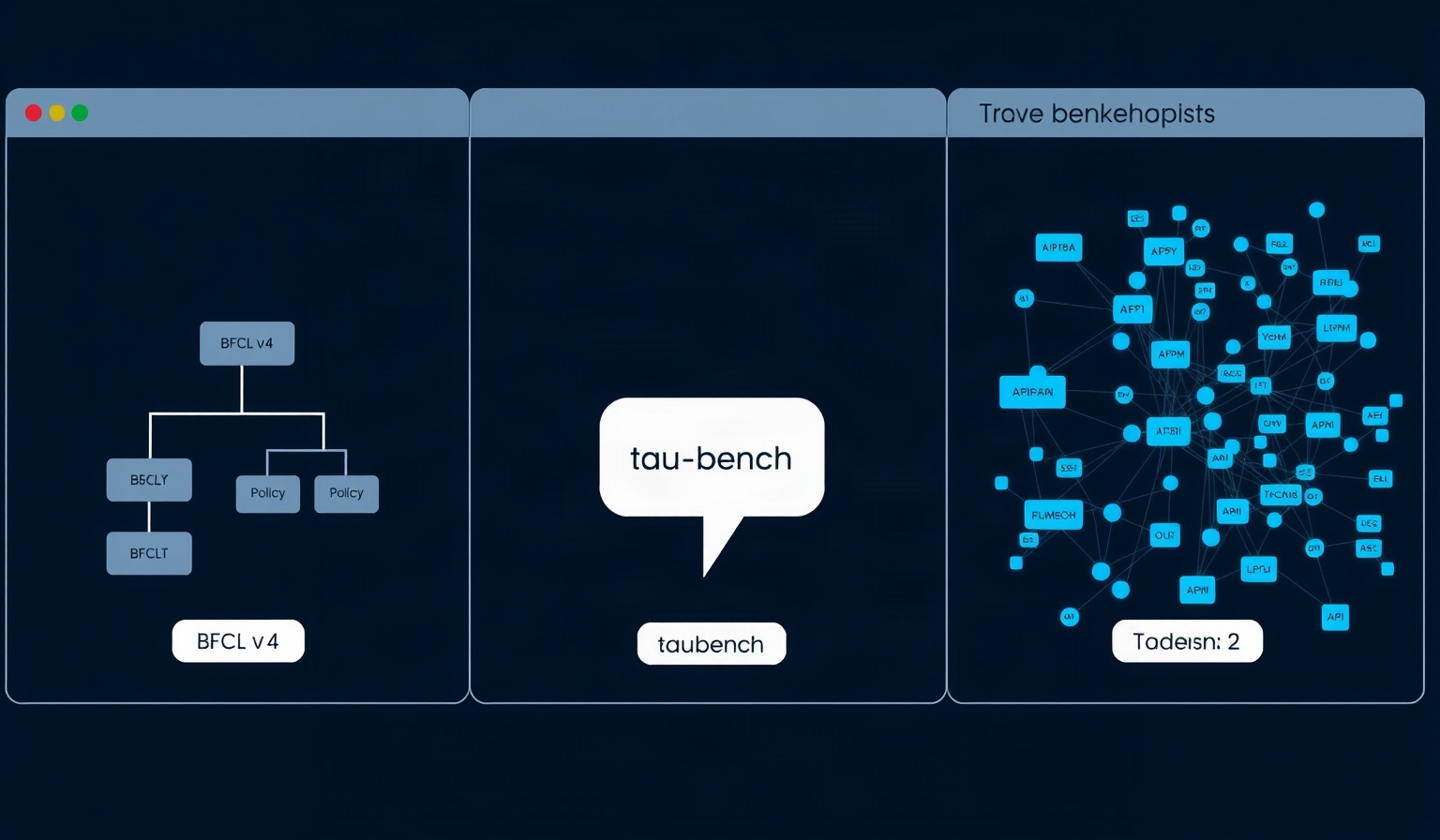
If you are building agents that call tools, the first question is not “which model wins” but “which benchmark actually measures what my agent does in production.” This tool calling benchmark comparison covers BFCL v4, τ-bench, and ToolBench — what each measures, where they diverge, and how to map their results to your stack.
How This Was Researched
This analysis is based on official leaderboards, papers, and documentation — we did not run the benchmarks hands-on. Sources include the BFCL V4 leaderboard, the τ-bench arXiv paper, the ToolBench arXiv paper, and the Spheron tool-calling guide. We did not cover T-Eval or MCP-Bench in depth, though both are referenced where relevant. Last researched: August 2026.
What BFCL V4 Actually Measures
BFCL V4, run by UC Berkeley’s Gorilla team, evaluates function selection, parameterization, and sequencing via AST-based comparison, with roughly 40% of its weight on agentic scenarios and 30% on multi-turn interactions — so a high score means your model can chain calls across turns, not just pick the right function once.
The remaining categories split as Live ~10%, Non-live ~10%, and Hallucination Measurement ~10%, across ~2,000+ test cases, per the BFCL V4 leaderboard. As of the August 2026 fetch, the top model is Claude-Opus-4-5-20251101 (FC) at 77.47 overall, followed by Claude-Sonnet-4-5-20250929 (FC) at 73.24, Gemini-3-Pro-Preview (Prompt) at 72.51, GLM-4.6 (FC thinking) at 72.38, and Grok-4-1-fast-reasoning (FC) at 69.57.
Agentic, Multi-turn, and Live Categories
The category weights matter more than the aggregate score. If your agent is a single-turn API wrapper, BFCL’s 40% agentic weight overstates your production difficulty; if your agent runs long-horizon tasks, the multi-turn 30% is the number to watch. The live category (~10%) pulls real-world API states, which catches models that overfit to static schemas.
What τ-bench Actually Measures
τ-bench measures success in multi-turn, policy-driven dialogues between a simulated user and an agent with access to tools, and it uniquely prioritizes policy compliance as a first-class metric alongside task completion — a dimension BFCL does not directly score.
Developed by Sierra and Shunyu Yao et al. (arXiv:2406.12045), τ-bench covers two domains: retail (~115 tasks) and airline (~50 tasks). A pass requires three things simultaneously: the user’s intent is satisfied, the database state matches the expected outcome, and the agent followed the written policy. The primary metric is pass@1, but the distinctive one is pass^k — the fraction of scenarios solved on all k rollouts. This is a reliability measure that falls as k rises, exposing models that succeed occasionally but not consistently.
The Policy-Compliance Metric
Policy compliance is what separates τ-bench from the field. A model can complete the task and still fail if it violates a stated rule — for example, issuing a refund without authorization. If your agent operates under regulatory or business constraints, τ-bench’s pass^k is a stronger predictor of production trustworthiness than a single-shot accuracy number. Note that τ2-bench (sierra-research/tau2-bench) extends this to multimodal, knowledge-aware, and voice domains, with a July 2026 grading update that re-graded banking_knowledge tasks.
ToolBench and the Breadth vs. Reproducibility Tradeoff
ToolBench offers massive API breadth — 16,000+ real APIs from RapidAPI (arXiv:2307.16789) — but it is expensive to run (days of GPU time) and less reproducible for direct model comparison than BFCL, which is why by 2026 it is mostly used for fine-tuning data generation rather than leaderboard-style evaluation.
The tradeoff is real. ToolBench’s strength is tool selection at scale: can the model find the right API among thousands? BFCL’s strength is tool execution quality: can it parameterize and sequence calls correctly? For production agents, you likely need both skills, but you rarely need to benchmark them with the same harness.
How do you compare tool calling benchmarks?
Comparison requires aligning a benchmark’s measured dimensions — like BFCL’s agentic focus or τ-bench’s policy compliance — with your agent’s production requirements; a single benchmark score is never sufficient, as the Spheron guide notes, so quote at least BFCL and τ-bench together.
Concretely, ask three questions. First, what failure mode is most costly? If wrong function calls are your top risk, BFCL’s AST-based comparison directly penalizes malformed parameterization. If policy violations are the risk, τ-bench is the only one of the three that catches them. Second, what is your interaction pattern? Single-turn tool use maps to BFCL’s non-live and live categories; long multi-turn dialogues map to τ-bench and BFCL’s multi-turn weight. Third, what is your scale? ToolBench’s 16,000+ API breadth is overkill for a stack with ten tools, and its cost makes it impractical for CI.
Practical Insights for Benchmarking Your Stack
Benchmark scores are harness-sensitive; the difference between native function calling and prompt-based parsing can change scores materially, so you must disclose your function-calling configuration when reporting any comparison, per the Spheron guide.
The same guide highlights concrete latency levers. Schema prefill adds 400–800 tokens per request; prefix caching (vLLM’s --enable-prefix-caching) mitigates this by reusing the schema’s KV cache across calls. Grammar-based constrained decoding, such as xgrammar, shifts grammar compilation to a one-time 20–50ms cost per schema rather than per token. Speculative decoding is effective on short JSON outputs, which dominate tool-calling workloads. For a deeper look at inference engine tradeoffs, see our LLM inference engine benchmark.
Harness Sensitivity and Latency
If you are evaluating models for your own stack, do not copy leaderboard harnesses blindly. The BFCL V4 leaderboard reports both native function calling (FC) and prompt-based (Prompt) variants — and the cost column shows why this matters: Gemini-3-Pro-Preview (Prompt) costs an estimated $298.47 for the full benchmark, while GLM-4.6 (FC) costs $4.64. Latency varies just as wildly: Claude-Opus-4-5 has a mean of 4.38s (P95 7.56s), while Gemini-3-Pro-Preview (FC) averages 15.87s with a P95 of 58.48s. If your agent serves interactive traffic, a 58-second P95 is a dealbreaker regardless of accuracy.
For production evaluation, build a small internal harness that mirrors your actual tool schemas and call patterns. The AI stack reference and the tools hub cover the infrastructure side; for benchmark methodology, pair BFCL with τ-bench results and always report your FC configuration. If you use MCP servers, consider MCP-Bench, which tests against real MCP server schemas (GitHub, filesystem, database) and is more production-realistic than BFCL’s synthetic schemas. For related reading, see our MCP server performance benchmark and our RULER vs LongBench v2 long-context retrieval comparison.
FAQ
Is BFCL v4 the best tool calling benchmark?
No single benchmark is best; BFCL v4 is the most comprehensive for function selection and sequencing, with ~2,000+ test cases and a 40% agentic weight (BFCL V4 leaderboard), but it does not measure policy compliance. For agents with regulatory constraints, τ-bench’s policy metric is irreplaceable. Use both.
What is the difference between BFCL and τ-bench?
BFCL v4 evaluates single and multi-turn function calling via AST-based comparison of the final call structure, scoring ~2,000+ cases across five weighted categories (BFCL V4 leaderboard). τ-bench evaluates end-to-end task completion in a simulated dialogue, requiring intent satisfaction, database state match, and policy compliance (arXiv:2406.12045). BFCL measures call correctness; τ-bench measures outcome correctness under policy.
Which tool calling benchmark should I use for production agents?
Use BFCL v4 to compare model function-calling ability and τ-bench to validate reliability and policy adherence in multi-turn scenarios; the Spheron guide recommends quoting both at minimum. For MCP-based stacks, add MCP-Bench for schema realism. Disclose your FC configuration and latency profile, as harness sensitivity can shift scores significantly.
📖 Related Reads
- ToolBrain — tool reviews, LLM comparisons, and AI workflow guides
- NiteAgent — AI agent development, frameworks, and production patterns
- Hermes Tutorials — Hermes Agent setup, configuration, and advanced workflows
Cross-links automatically generated from CodeIntel Log.