Long-Context Retrieval Benchmarks: RULER vs LongBench v2
RULER's synthetic sweeps — key-value retrieval, multi-hop tracing, aggregation — localize failure points via scaling curves but lack naturalistic…
Long-Context Retrieval Benchmarks: RULER vs LongBench v2
A large context window is not evidence of long-context competence. Modern models advertise 200K, 1M, even 2M-token contexts, yet frequently fail at simple retrieval tasks half that length. The gap between marketing and measured capability is real, and it costs you production reliability. This post cuts through the hype with a benchmark comparison and a practical evaluation blueprint.
How This Was Researched
This analysis is based entirely on official documentation, benchmark papers, and repository code — we did not run the benchmarks hands-on. Primary sources include the RULER paper, LongBench v2 paper, LongBench v1 paper, the needle-in-a-haystack repo, and the NVIDIA/RULER and THUDM/LongBench repositories.
We did not cover vendor-specific internal evals or unreleased benchmarks. The analysis focuses on publicly available, reproducible methodologies. Last researched: August 2026.
Which Long-Context Retrieval Benchmark Should You Use?
Use RULER for controlled failure localization, LongBench v2 for naturalistic understanding, and needle-in-a-haystack only as a quick positional sanity check — no single benchmark suffices, per the RULER paper and LongBench v2 paper. Production evaluation requires all three layers plus operational metrics.
| Benchmark | Primary Use Case | Key Strength |
|---|---|---|
| RULER | Failure localization | Configurable synthetic sweeps |
| LongBench v2 | Naturalistic understanding | Real documents, 6 task types |
| Needle-in-a-Haystack | Quick smoke check | Positional recall only |
What RULER Actually Measures (and Its Limits)
RULER measures synthetic retrieval and reasoning across configurable sweeps over sequence length, needle position, retrieval depth, and task type, producing scaling curves that localize exactly where models fail, per the RULER paper and NVIDIA/RULER. You get precise failure points, not vague pass/fail signals.
The limit is ecological validity. RULER’s synthetic tasks — key-value retrieval, multi-hop tracing, aggregation — do not resemble real documents. A model can score well on RULER yet fail on messy production text. Use RULER to find where degradation starts, then validate with naturalistic benchmarks. The RULER paper explicitly frames it as a diagnostic tool, not a final verdict.
LongBench v2: Naturalistic Long-Context Understanding
LongBench v2 evaluates 503 questions across 6 task categories using real documents, with grading performed by both humans and models — the benchmark most likely to predict production performance, per the LongBench v2 paper and THUDM/LongBench. Questions require deep context understanding, not surface retrieval.
The tasks span summarization, question answering, code completion, and more. Because documents are real, LongBench v2 surfaces issues RULER cannot: noisy irrelevant passages, ambiguous queries, and multi-passage synthesis. Its weakness is interpretability — you get an accuracy number but less clarity on why a model failed. Pair it with RULER sweeps for diagnosis. The LongBench v1 paper established the lineage, and v2 extends it significantly.
Needle-in-a-Haystack: The Misleading Quick Check
Needle-in-a-haystack tests insert a single fact into a long context and check if the model recalls it — measuring positional recall only, per the LLMTest_NeedleInAHaystack repository. It cannot assess multi-passage synthesis, reasoning over distributed information, or robustness to noisy distractors, so a model can score 100% and still fail real workloads.
The misleading part is the marketing appeal: a clean heatmap showing green across context lengths looks impressive. But that green only proves the model can find one planted sentence. Google long-context docs and Anthropic context windows both caution against treating needle tests as comprehensive evals. Use them as a 5-minute smoke check before deeper evaluation, never as the final word.
Comparison Matrix: Choosing Your Evaluation Layer
The right evaluation layer depends on what you need to learn: diagnostic precision, real-world validity, or quick positional sanity — and each benchmark answers a different question, per the RULER paper and LongBench v2 paper. Choose based on your failure-analysis needs.
| Benchmark | Task Type | Strengths | Weaknesses | Best For |
|---|---|---|---|---|
| RULER | Synthetic configurable tasks | Failure localization, scaling curves, controlled sweeps | Not naturalistic, no real documents | Diagnosing where models break |
| LongBench v2 | Naturalistic real-document tasks | Real-world validity, 6 task categories, human+model grading | Less interpretable failure modes | Predicting production performance |
| LongBench v1 | Naturalistic tasks (older set) | Established baseline, broad coverage | Smaller scale, less depth than v2 | Historical comparison |
| Needle-in-a-Haystack | Single-fact positional recall | Fast, simple, easy to visualize | Shallow, no synthesis, misleadingly high scores | Quick smoke checks |
Building a Production Long-Context Evaluation Program
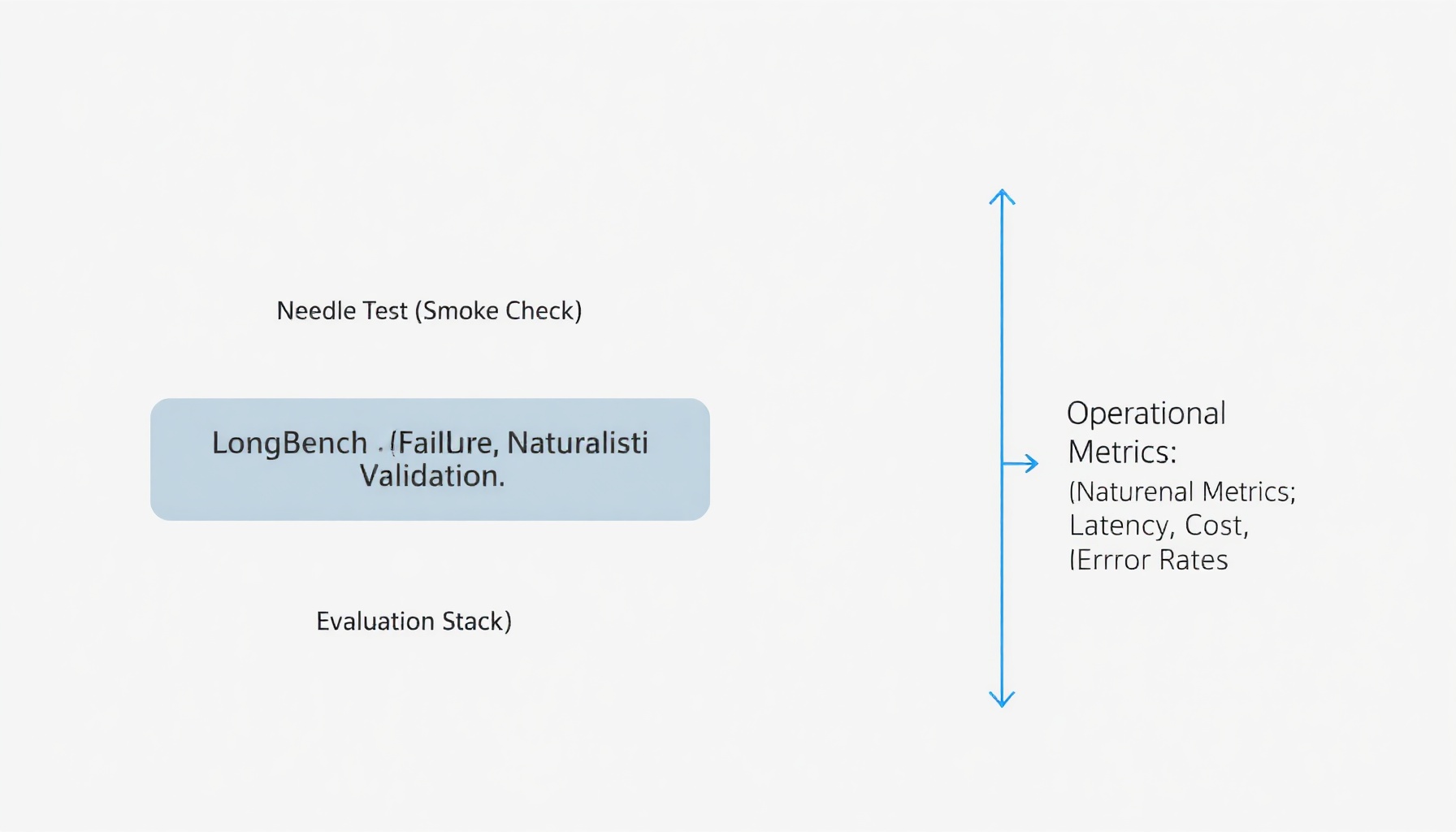
A production-grade program layers all three benchmark types: needle tests as daily smoke checks, RULER sweeps for weekly failure localization, and LongBench v2 for monthly validation against real-world tasks — built on a production eval harness foundation. Report failure curves (accuracy versus context length), not a single max-context score.
You must also pin model IDs, tokenizers, and seeds for reproducibility. Run 5-10 trials per test cell to account for sampling variance. Check for data contamination by comparing benchmark questions against your training corpus; if a model has seen the answers, the eval is meaningless. This layered approach, informed by benchmark selection for code tasks, gives you actionable signals rather than marketing numbers.
Operational Metrics: Beyond Raw Accuracy
Accuracy is necessary but insufficient for production — you must measure latency, time-to-first-token, throughput, cost per request, and error rates separately from accuracy, per our inference engine benchmark. A model that is 5% more accurate but 3x slower may be the wrong choice.
Operational metrics should be collected in the same harness as accuracy, with identical prompts and context lengths. This lets you compute cost-per-correct-answer, a metric that combines accuracy with economics. Track error rates by failure type (retrieval miss, hallucination, truncation) to prioritize fixes. The RULER paper and LongBench v2 paper focus on accuracy, but production requires the full operational picture.
FAQ
How many runs per test cell do I need for reliable long-context benchmark results?
Run 5-10 trials per test cell as a baseline, but increase to 20-30 when the accuracy difference between models is under 5%. Long-context tasks exhibit high variance due to sampling and positional effects, per the LongBench v2 paper. Report mean and confidence intervals, not single runs.
Can I use needle-in-a-haystack results alone to evaluate a long-context model?
No. Needle tests measure only single-fact positional recall, per the LLMTest_NeedleInAHaystack repository. They miss multi-passage synthesis, reasoning, and robustness to noise. Use them as a smoke check only, then validate with RULER and LongBench v2 before making production decisions.
How do I check for data contamination in long-context benchmarks?
Run benchmark questions through your training-data pipeline and search for near-duplicate matches. Check if the model can answer questions without the provided context — if it can, contamination is likely. Use held-out or dynamically generated variants when available, per the LongBench v2 paper’s methodology.
📖 Related Reads
- ToolBrain — tool reviews, LLM comparisons, and AI workflow guides
Cross-links automatically generated from CodeIntel Log.