Long-Horizon AI Agent Benchmark: The 50-Step Gap
Long-Horizon-Terminal-Bench exposes a 50-step cliff: accuracy falls 62%→45%→28%, failures clustering at transition points via context loss, error…
Long-Horizon AI Agent Benchmark: The 50-Step Gap
How This Was Researched
This review of long-horizon AI agent benchmarks is based on official documentation, published leaderboards, and peer-reviewed research — we did not run these models hands-on. The three primary sources are the Long-Horizon-Terminal-Bench paper (arXiv 2607.08964), the DeepSWE blog, and the SWE-bench Pro leaderboard.
Why do AI agents fail on long-horizon tasks?
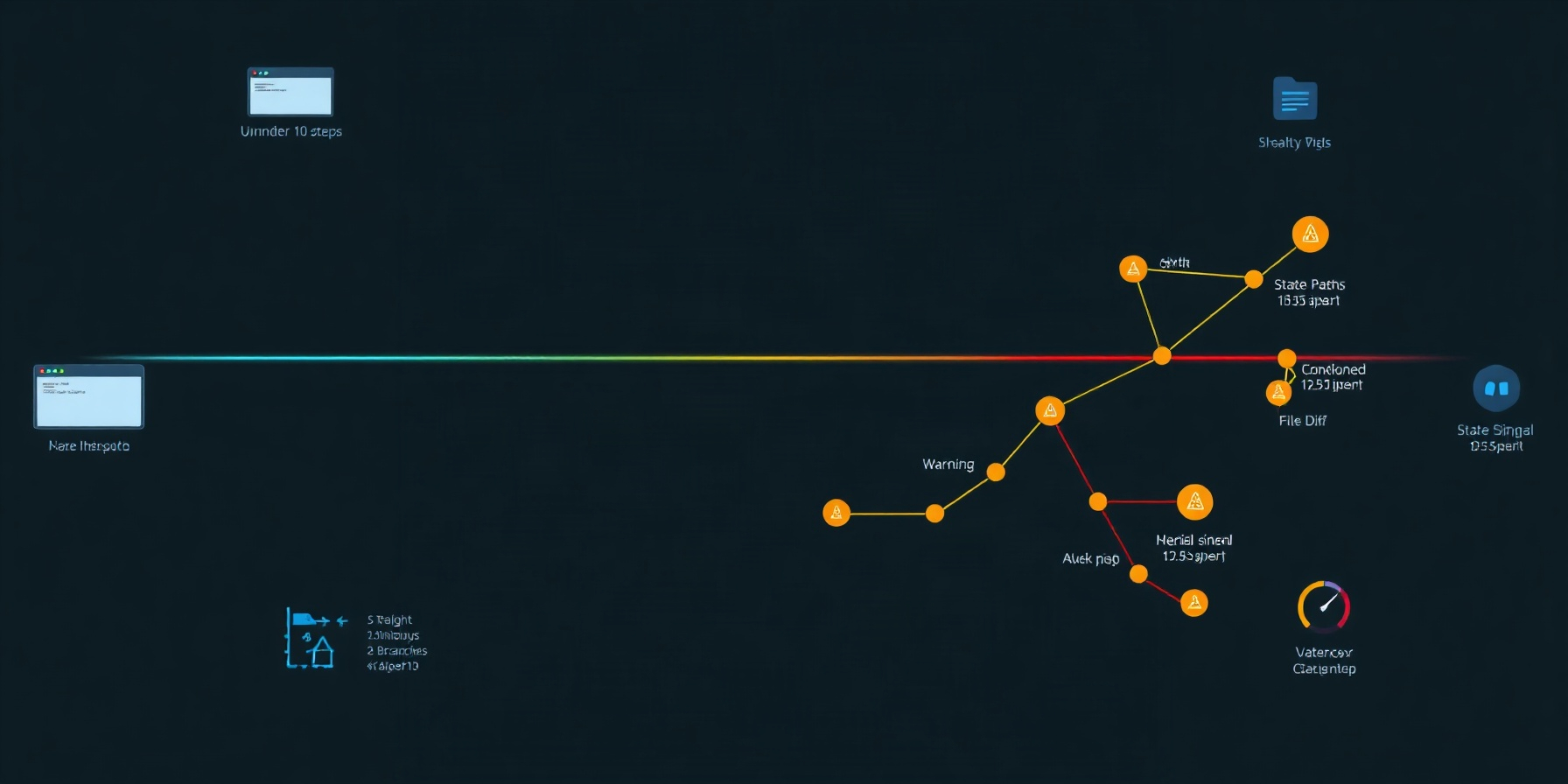
The performance cliff is stark: on Long-Horizon-Terminal-Bench, short tasks under 10 steps score 62%, medium tasks between 10 and 50 steps score 45%, and long tasks exceeding 50 steps drop to 28% — a roughly 34–35 percentage-point gap between short and long horizons, with failures clustering at transition points between subtasks rather than distributing uniformly Long-Horizon-Terminal-Bench paper. The 50-step threshold marks the point where frontier models materially degrade.
Transition points are where the agent must carry context from one completed subtask into the next. At each boundary, three compounding problems emerge: context loss (the model forgets earlier decisions), error propagation (a small mistake amplifies through subsequent steps), and state-tracking breakdowns (the agent loses track of which files, variables, or system states it has already modified). Short-horizon tasks avoid this because the entire context fits cleanly in the model’s working memory. The long-horizon AI agent benchmark data confirms that reliability is not linear — it degrades sharply past the 50-step boundary, which is the central thesis of this post.
What does Long-Horizon-Terminal-Bench measure?
Long-Horizon-Terminal-Bench evaluates agents on terminal-based tasks across three horizon buckets — short, medium, and long — using dense reward grading that assigns partial credit rather than binary pass/fail, which enables granular failure analysis Long-Horizon-Terminal-Bench paper. The benchmark reveals that models degrade at different rates as horizon lengthens, with the 62%/45%/28% score progression documented in the paper.
Dense reward grading matters because it shifts the field from asking “did the agent succeed?” to “where did the agent fail?” Binary pass/fail grading hides the failure distribution — an agent that completes 90% of a long task and an agent that completes 10% both receive a zero. With partial credit, researchers can pinpoint exactly which transition points break. The three horizon buckets (under 10 steps, 10–50, over 50) provide a standardized way to compare how different models handle increasing task complexity, making this AI agent terminal task benchmark one of the most diagnostic tools currently available.
How does DeepSWE test software-engineering durability?
DeepSWE contains 113 tasks across 91 repositories in 5 languages — TypeScript 35, Go 34, Python 34, JavaScript 5, Rust 5 — written from scratch to be contamination-free, with prompts averaging 2,158 characters versus SWE-bench Pro’s 4,614, and mean reference lines added of 668 versus Pro’s 120 and Verified’s 10 DeepSWE blog. The benchmark is designed to stress durability rather than pattern-matching.
Contamination-free construction ensures the models haven’t seen these tasks during training, which is critical for reliable coding agent reliability benchmark results. The shorter prompts combined with substantially more output tokens (roughly 2x SWE-bench Pro) reflect a harder real-world signal: the agent must infer more from less instruction. The multi-file edit requirement — a mean of 7 files changed versus Pro’s 5 and Verified’s 1 — forces the agent to maintain coherent state across multiple files simultaneously, which directly stresses the same transition-point weaknesses identified by Long-Horizon-Terminal-Bench. This is why DeepSWE’s design connects so directly to the long-horizon narrative: it measures sustained multi-step reasoning, not single-file patching.
How much do verification errors distort benchmark results?
A verifier audit across 30 tasks × 3 rollouts × 10 configurations (n=735 for DeepSWE, n=789 for SWE-bench Pro) found SWE-bench Pro has 8.5% false positives and 24.0% false negatives, while DeepSWE has 0.3% false positives and 1.1% false negatives DeepSWE blog. False negatives matter more than false positives for ranking accuracy.
A 24% false negative rate in SWE-bench Pro means nearly one in four correct solutions is penalized. This compresses the leaderboard spread — when a quarter of correct answers are marked wrong, the difference between a strong model and a weak model narrows artificially. The distortion is especially problematic for the agent gap research because it masks the true capability difference between frontier models. If your evaluation tool cannot distinguish a correct solution from an incorrect one, the resulting rankings tell you more about the verifier’s blind spots than about model capability.
What do Pass@1, cost, tokens, and steps show?
The DeepSWE v1.1 leaderboard (August 13, 2026, mini-swe-agent harness) shows Pass@1 ranging from 36% (gemini-3.5-flash) to 74% (claude-opus-5), with cost per solved task spanning $0.10 (deepseek-v4-flash) to $26.40 (claude-sonnet-5) DeepSWE blog. The full verified results follow.
| Model | Pass@1 | Cost/Solved Task | Output Tokens | Steps |
|---|---|---|---|---|
| claude-opus-5 [max] | 74%±4% | $11.84 | 118k | 99 |
| gpt-5.6-sol [max] | 73%±3% | $8.39 | 60k | 61 |
| claude-fable-5 [max] | 70%±4% | $21.63 | 119k | 88 |
| kimi-k3 [max] | 69%±5% | $4.65 | 81k | 98 |
| gpt-5.6-luna [max] | 67%±4% | $0.61 | 73k | 102 |
| gpt-5.5 [xhigh] | 67%±6% | $7.23 | 46k | 82 |
| grok-4.6 [xhigh] | 67%±2% | $5.50 | 71k | 87 |
| gemini-3.7-flash [high] | 65%±2% | $2.18 | 107k | 125 |
| deepseek-v4-pro [max] | 63%±6% | $0.24 | 106k | 155 |
| claude-opus-4.8 [max] | 59%±2% | $13.22 | 135k | 120 |
| qwen3.8-max [xhigh] | 57%±3% | $3.73 | 95k | 111 |
| muse-spark-1.2 [xhigh] | 55%±2% | $3.70 | 99k | 101 |
| claude-sonnet-5 [max] | 54%±4% | $26.40 | 214k | 268 |
| deepseek-v4-flash [max] | 53%±4% | $0.10 | 108k | 153 |
| gemini-3.6-flash [high] | 47%±4% | $2.21 | 96k | 117 |
| glm-5.2 [max] | 44%±2% | $3.92 | 78k | 129 |
| gemini-3.5-flash [high] | 36%±4% | $3.45 | 76k | 105 |
The cost-efficiency frontier is notable: kimi-k3 delivers 69% Pass@1 at $4.65 per solved task, while gpt-5.6-luna achieves 67% at just $0.61. Contrast this with claude-sonnet-5, which is the most expensive at $26.40 per solved task yet sits mid-pack on accuracy — its 268 steps explain the cost. Step count serves as a proxy for both task difficulty and agent thrashing; claude-sonnet-5’s 268 steps versus gpt-5.6-sol’s 61 steps on comparable Pass@1 scores suggests significant inefficiency. These numbers reinforce why LLM caching at scale and token optimization matter for production economics.
What should production agent scaffolding change?
Production scaffolding must account for the 50-step durability cliff: implement checkpoint-and-restart patterns, budget cost ceilings per task, instrument step-count monitors with automatic escalation, and prefer models with lower cost-per-solve over raw Pass@1 Long-Horizon-Terminal-Bench paper. These findings from Long-Horizon-Terminal-Bench and DeepSWE directly inform architecture decisions.
First, implement checkpoint and rollback at subtask boundaries. Since failures cluster at transition points, save agent state after each completed subtask and enable rollback to the last good checkpoint when the agent stalls. Second, build cost-budget circuit breakers — abort and re-route after a configurable step count or dollar threshold, using rate-limiting gateways to enforce these ceilings. Third, select models by cost-efficiency frontier rather than headline accuracy; a 67% model at $0.61 per solved task beats a 74% model at $11.84 for most production workloads. Finally, implement a verification layer — given SWE-bench Pro’s 24% false negative rate, never trust single-pass binary grading in your own evaluations; use multiple verifiers or human spot-checks. For deeper guidance, consult our stack guides and our tools directory for implementation patterns.
FAQ
How many steps can current AI agents handle reliably?
Current frontier models handle short tasks (under 10 steps) at 62% success, but reliability drops to 28% for tasks exceeding 50 steps on Long-Horizon-Terminal-Bench Long-Horizon-Terminal-Bench paper. The 50-step boundary represents a consistent durability cliff across models.
Is SWE-bench still the best coding agent benchmark?
SWE-bench remains widely used but has significant verifier reliability issues — 24% false negatives and 8.5% false positives in an independent audit DeepSWE blog. Newer benchmarks like DeepSWE and Long-Horizon-Terminal-Bench offer denser grading and contamination-free tasks.
What is the cheapest model that passes DeepSWE?
deepseek-v4-flash achieves 53% Pass@1 at $0.10 per solved task, the lowest cost on the leaderboard DeepSWE blog. For higher accuracy, gpt-5.6-luna offers 67% Pass@1 at $0.61 per solved task.
📖 Related Reads
- NiteAgent — AI agent development, frameworks, and production patterns
- ToolBrain — tool reviews, LLM comparisons, and AI workflow guides
Cross-links automatically generated from CodeIntel Log.