DeepSeek Harness: A Plugin-Everything Agent Harness Built on a Formal Foundation
An architecture-first deep-dive into DeepSeek Harness: its plugin-everything runtime, event-sourced session log, and the patterns builders should copy or avoid.
Five days after creation, deepseek-ai/deepseek-harness sits at 157,621 stars and 16,376 forks (GitHub). Created 2026-08-13, MIT-licensed, TypeScript, and flagged as a v0.1 developer preview with a README warning that “THERE WILL BE COMPATIBILITY-BREAKING CHANGES.” DeepSeek’s thesis, per DeepSeek’s harness page, is “Agent = Model + Harness.” This review examines the architecture from the repository source and documentation — not from hands-on testing — to assess what harness builders should study and what they should avoid in production.
1. Why Harness Builders Should Care: “Agent = Model + Harness”
Model providers ship models; a harness keeps agents working in real-world environments. DeepSeek Harness’s thesis is that every capability — models, tools, skills, sessions, sandboxes, storage, the loop, scheduling, UI — should be swappable and recomposable in config with fully traceable runs, per DeepSeek’s harness page. That reframes the harness from a fixed product into a composable platform.
2. The Cordis Foundation: A Harness Where Everything Is a Plugin
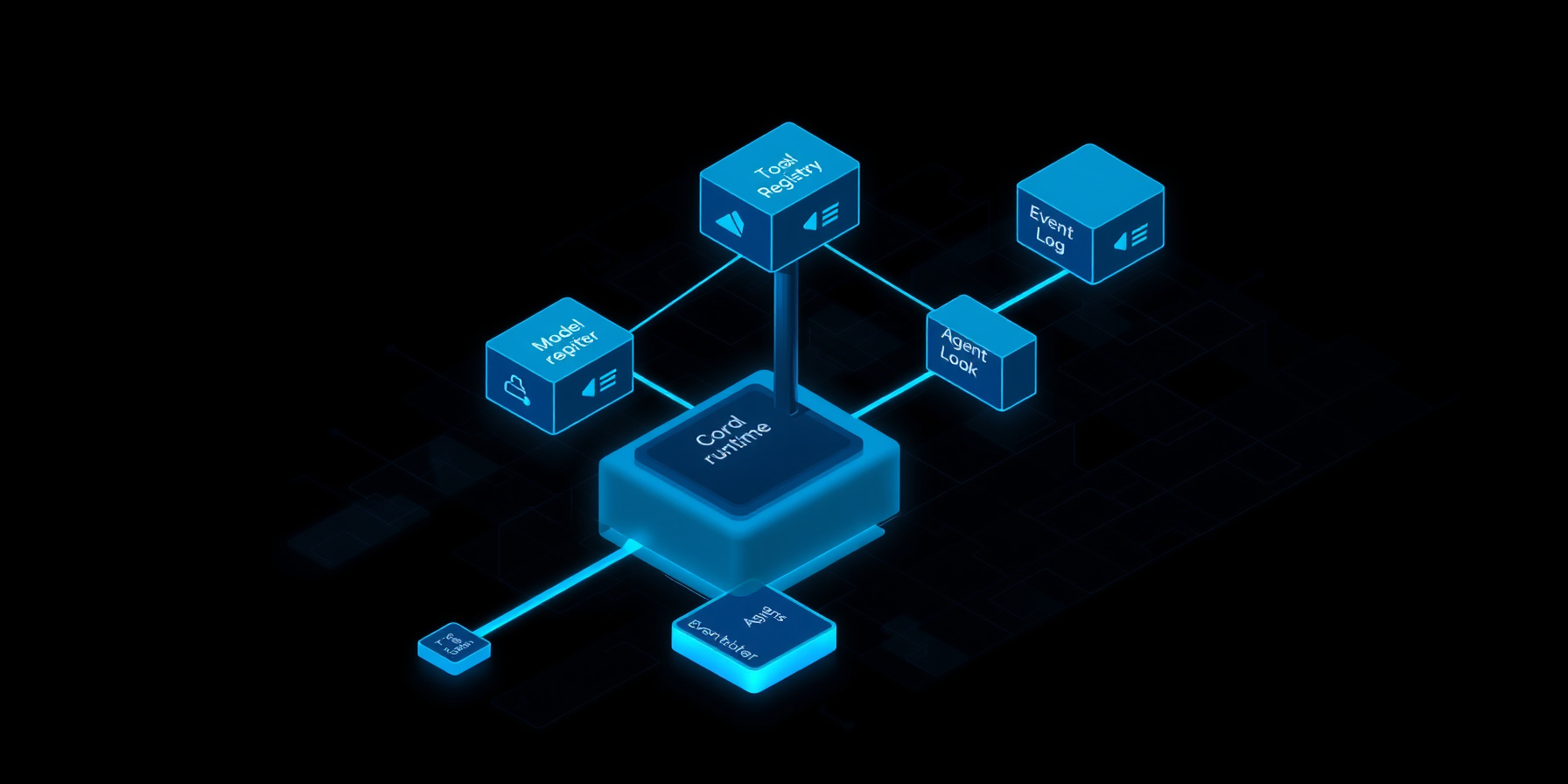
The core architectural bet is that no component is privileged — the model adapter, tool registry, session log, and agent loop are all plugins mounted on the Cordis meta-framework, making extension equivalent to mounting another plugin (architecture doc). This section details the plugin mechanics and their implications for harness builders.
2.1 No Privileged Core: The Loop Is a Plugin
The model adapter, tool registry, session log, and agent loop are all plugins; “there is no privileged core to patch.” Registrations are effects that unwind on unload, so removing a component fully reverts its side effects (architecture doc). For harness builders, this means the agent loop itself is replaceable in config, not something you work around.
2.2 Context as a Service Repository
Plugins claim stable ctx.<key> slots (ctx.tools, ctx.llm, ctx.sessions, ctx.agents, ctx.agentLoop); consumers find services by key, never by importing a concrete implementation. Dependencies are declared via inject, so load order follows service requirements, not manual boot sequencing (architecture doc + Cordis primer). This is a clean inversion-of-control pattern worth copying.
2.3 Typed Events with Four Dispatch Modes
Events dispatch in four modes: emit (fire-and-forget), waterfall (around-middleware with next(); short-circuit by not calling it), parallel (awaited, fanned out), serial (awaited, ordered, returns a value). agent/pre-step, agent/request, llm/stream, tools/* are waterfalls; agent/turn-stopping is a serial terminal. Dispatch mode is documented per event and machine-checked (architecture doc). This gives predictable middleware semantics for policy enforcement.
3. The Formal Paradigm: Spatiotemporal Composability
DeepSeek Harness implements a formal paradigm from the cordiverse/paper research: revertible effects for temporal composability and reactive coeffects for spatial composability (Cordis paper repo). This is not marketing — the runtime implements these abstractions directly, with Cordis vendored into the tree.
3.1 Temporal Composability: Revertible Effects
Every context transformation carries an inverse that the runtime tracks; removing a component fully reverts its side effects (Cordis paper repo). This means unload is deterministic: no orphaned registrations or leaked services when a plugin is removed.
3.2 Spatial Composability: Reactive Coeffects
Components declare dependencies and react to context changes against their coeffect spec, implemented via a declarative component loader with config reconciliation and hot module replacement (Cordis paper repo). The preprint draft is dated 2026-08-13 — the same day as the dsh release — signaling the formal paradigm is load-bearing. Cordis itself (cordiverse/cordis, 5,974 stars) is vendored inside dsh in vendor/ with a documented sync procedure in vendor/README.md.
4. Composition in Practice: Profiles, Bundles, Patches
A running dsh is a plugin tree composed at boot from ordered layers: profile, bundles, patch files, and CLI overlays, so any row in the dumped config is replaceable by a user patch. The web and headless profiles share one tree, with dsh-base carrying adapters, tools, persistence, and sandbox policy.
Layer order: profile → bundle list → bundle patch files → profile cordis.patch.yml → home-level patch → --patch CLI overlay; dsh-web-app adds the browser app and dsh-headless is a one-shot runner with no server (architecture doc).
5. The Event-Sourced Session Log Is the System of Truth
The session log is not a debugging aid; it is the system of truth. A runtime invariant asserts anything model-visible is reconstructable from the append-only SessionEvent log (architecture doc). This section explains the invariant and its derivations across replay, transcripts, and telemetry.
5.1 The Invariant: Model-Visible Means Logged
Anything reaching a model request must be reconstructable from the append-only SessionEvent log; new model-visible input requires a new durable event type (extend SessionEventMap). The log schema is the product’s hard contract (architecture doc). This is a strong invariant for auditability and replay.
5.2 One Stream, Many Derivations
deriveMessages() projects model history from the log; raw assistant/chunk events preserve replay/UI fidelity. Fork, resume, search, replay, transcripts, telemetry, and persistence all derive from this one stream. Event domains include durable session events vs live agent/* control events (inbox, step, status, request, continuation) vs capability events (fs/*, tools/*, telemetry/*) that attach policy without importing the loop (architecture doc).
6. The Turn/Step Lifecycle: Waterfall Policy and Compaction
A step is one model request plus the tools it calls; a turn is zero or more steps that opens before the first input is claimed and closes when nothing is owed. The agent/pre-step waterfall decides what the model sees, and tools run through pre-execute, execute, and ordered post-execute phases.
Compaction (dsh-compaction-basic) hooks agent/pre-step for pressure and agent/request-error for canonical context overflow, pruning tool results before summary selection; a rejected first claim still closes a durable turn that spent no step (architecture doc).
7. Capability Seams: One Provider Swap Changes the Whole Product
A seam is a Service Definition, a Service Provider, and a Consumer, usually a model-facing tool. Verified seams cover ctx.llm, ctx.sandbox, ctx.subprocess, ctx.sessionPersistence, ctx.web, and ctx.subagents, each with swappable providers — local or E2B sandboxes, and even Claude Code or Codex as subagent backends.
Provider sets: ctx.llm (llm-deepseek, llm-pi-ai, llm-replay); ctx.sandbox (sandbox-local, e2b; fs-sandbox, subprocess-e2b, bash-sandbox); ctx.subprocess (subprocess-local, subprocess-e2b); ctx.sessionPersistence (jsonl + sqlite); ctx.web (exa, perplexity, deepseek search + http fetch); ctx.subagents (subagent-inprocess, subagent-acp, subagent-codex, subagent-claude-code) plus hooks-claude-code / hooks-codex (capability-seams doc). Key insight: filesystem and subprocess providers share one execution world, so pointing ctx.fs/ctx.subprocess at a remote sandbox moves Bash, PTY, and LSP with it.
8. Four Runtime Modes from One Plugin Tree
DeepSeek Harness ships four runtime modes from one plugin tree (DeepSeek’s harness page): Standard, a full coding agent; Code, the same tools behind a Code Mode SDK; Minimal, a two-tool agent for benchmarking; and Creator, for runtime inspection and plugin experiments. Mode-as-config means benchmarking and full-agent use share one codebase.
Standard covers file editing, shell, file+web search, skills, planning, goals, subagents, and workflows; Code lets the model compose multi-step operations in one TypeScript program; Minimal ships persistent bash plus str_replace_editor; Creator supports in-memory Cordis plugin experiments and preset authoring.
9. DeepSeek Harness vs. the Field
The comparison below positions dsh against incumbent tools across architectural dimensions, from license and core architecture to session traceability, sandboxing, and maturity. dsh cells state verified facts; alternative-side cells are architectural analysis grounded in public documentation, not vendor-fetched specs, and the table’s framing makes that distinction explicit.
| Dimension | DeepSeek Harness | Claude Code | Codex (CLI) | OpenClaw / ZeroClaw | LangGraph |
|---|---|---|---|---|---|
| License / openness | MIT, open source | Proprietary CLI | Proprietary CLI | MIT, open source | MIT, open source |
| Core architecture | Plugin tree on Cordis meta-framework; no privileged core | Monolithic agent + lifecycle hooks | Monolithic agent; cloud sandbox | Plugin-centric self-hosted harness | Graph/state-machine orchestration library |
| Extensibility model | Everything is a plugin, incl. the loop; profiles/bundles/patches in config | Hooks for lifecycle events | Limited extension surface | First-class plugin ecosystem | Custom nodes, edges, checkpointer |
| Session traceability | Append-only SessionEvent log; “model-visible means logged” | Session transcripts; no replay invariant | Cloud session history | Local sessions + knowledge graph | State snapshots via checkpointer |
| Sandbox / execution | Pluggable ctx.sandbox: local or E2B; fs+subprocess share execution world |
Local exec, sandbox via hooks | Cloud sandbox default | Local runner | Bring-your-own executor |
| Subagents / interop | ctx.subagents: in-process, ACP, Codex, Claude Code + hooks packages |
Built-in subagents | Built-in subagents | ACP support | Supervisor/swarm built-ins |
| Runtime modes | Standard / Code / Minimal / Creator from one plugin tree | Plan/auto modes | Minimal exec mode | Assistant modes | N/A (library) |
| Formal foundation | Spatiotemporal composability paper; Cordis vendored | None | None | None | Graph semantics; no agent calculus |
| Maturity | v0.1 developer preview (2026-08-13); breaking changes promised | GA, mature | GA, mature | Mature community | Mature library |
The interop-first posture is notable: dsh ships subagent-claude-code + hooks-claude-code and subagent-codex + hooks-codex (GitHub), positioning itself as the harness around other harnesses rather than a replacement. What dsh uniquely offers is the formal foundation, the event-sourced invariant, the no-privileged-core design, and engineering rigor (Typert, verbatim-doc gates — see development doc). The honest gaps: 5 days old, v0.1 preview, breaking changes promised, and a thin plugin ecosystem so far (dsh-plugin topic).
10. Production Tradeoffs of a Five-Day-Old Preview
The docs surface five concrete tradeoffs: compatibility-breaking churn is accepted during preview; the event-log invariant makes the log schema a hard contract; vendored Cordis puts the upgrade burden on you; the dual-aggregate TypeScript build is genuinely unusual; and rigor signals like keyless CI and a type-equivalence gate are built in.
(1) No privileged core means everything is patchable, but the team accepts churn — the README flags “THERE WILL BE COMPATIBILITY-BREAKING CHANGES”; (2) any new model-visible input requires a new durable event type; (3) the Cordis sync procedure is documented, but upgrades are yours; (4) both Host and Client sides declaration-merge the Cordis Context interface under the same keys with different services, so a single ts.Program reports a collision — the monorepo keeps tsconfig.host.json/tsconfig.client.json as separate programs bridged by a split api/remotes package using Typert runtime type reflection; (5) worktree-local Git hooks, a bilingual-docs merge driver, and a ts type-equiv gate asserting doc snippets stay byte-equivalent to source declarations (development doc).
11. FAQ
This FAQ answers the three most common questions from harness builders evaluating dsh: whether it replaces Claude Code or Codex, what plugin-everything means for an existing stack, and whether production teams should adopt v0.1 today. Answers draw on the verified repository facts and documentation cited throughout.
11.1 Is DeepSeek Harness a drop-in replacement for Claude Code or Codex?
No. It is interop-first: dsh delegates turns to Claude Code and Codex as swappable subagent backends behind the ctx.subagents seam and ships compatibility hooks (GitHub). The target audience is harness builders, and it is MIT vs proprietary CLIs.
11.2 What does “everything is a plugin” mean for an existing agent stack?
No privileged core: adapters mount into ctx.* service slots, dependencies are declared via inject, registrations are revertible effects that unwind on unload, and the loop itself is replaceable in config (architecture doc).
11.3 Should production teams adopt v0.1 today?
Treat as a study-and-experiment release, not a production dependency: developer preview, compatibility-breaking changes promised, plugin ecosystem early (dsh-plugin topic). Third-party reporting confirms the preview framing (Global Times). Pin versions and watch for a stabilizing release.
12. How This Review Was Researched
This review is based on the repository source, documentation, and issue tracker — we did not run it hands-on. The method: GitHub REST API facts fetched on 2026-08-18, repository docs pulled from the master branch, the official product page, and the official developer docs.
Sources: architecture, development, and capability seams docs; deepseek.com/harness; the quickstart and Cordis primer; the formal paradigm from cordiverse/paper; the vendored runtime from cordiverse/cordis. All cited URLs returned HTTP 200 at fetch time; the repo was five days old at publication, so docs and APIs are moving targets, and comparison rows are architectural analysis grounded in verified dsh facts.
13. The Bottom Line
DeepSeek Harness is the most architecturally ambitious open-source agent harness to date — a formally motivated, plugin-everything runtime with an event-sourced session log as its system of truth. For harness builders: study it and steal the patterns; do not put production workloads on v0.1 yet.
- Copy the seam triple (Service Definition + Provider + Consumer) for clean provider swaps.
- Adopt the “model-visible means logged” invariant for auditability and replay.
- Use waterfall dispatch as policy middleware —
agent/pre-stepis a clean interception point. - Steal mode-as-config — one plugin tree, multiple runtime profiles.