Ponytail: A 100-Line Prompt That Scored 113k Stars
Ponytail turned a tiny YAGNI prompt into a viral agent skill, and this review examines its ladder, benchmarks, and the engineering lessons teams can copy.
Ponytail: A 100-Line Prompt That Scored 113k Stars
Ponytail is a ~100-line markdown skill that restates YAGNI, wrapped in 6,232 lines across 90 files Eberhardt’s post. It has 113,413 stars and 6,201 forks two months after creation GitHub repo. The product is the prompt; the repo is the packaging.
This review is part of our GitHub trending repo coverage, produced through the arena pipeline.
How This Review Was Researched
This review is based on the repository source, documentation, and issue tracker — we did not run it hands-on. We verified 12 sources via HTTP 200 checks on 2026-08-27, including the GitHub API for star/fork counts, the SKILL.md source, benchmark results, and issue threads. We did not independently reproduce the benchmark results. Last reviewed: August 2026.
What Is Ponytail, Actually?
Ponytail is a prompt-as-product experiment: a ~100-line SKILL.md that restates YAGNI (You Aren’t Gonna Need It) with unusual precision, packaged as a distributable agent skill Eberhardt’s post. The repository, created 2026-06-12 under MIT license, contains 6,232 lines across 90 files — the vast majority being harness adapters, tests, and tooling, not prompt content GitHub repo.
The meta-irony: the ruleset was largely written by Claude, an AI system that would benefit from the very discipline it encodes. The core instruction set fits on a single screen — “lazy about the solution, never about reading” — yet the project ships with lifecycle hooks, drift-detection scripts, and a benchmark suite as first-class code SKILL.md.
The architectural insight is that a prompt’s effectiveness degrades with context drift across hosts. Ponytail treats the prompt as a versioned artifact with tests, not a text file you paste into a system message.
Why Did a YAGNI Prompt Hit 113k Stars in Two Months?
InfoQ reported on August 5 that Ponytail was “one of the fastest-growing repositories of the summer” at 82,000 stars — meaning roughly 31,000 additional stars accumulated in the following three weeks InfoQ. The HN thread drew 98 points of debate over whether the project is a genuine advance or a well-packaged truism HN thread.
The growth pattern suggests two distinct adoption waves. First, individual developers curious about prompt engineering as a discipline. Second, engineering teams evaluating whether the harness-adapter architecture solves their multi-tool drift problem — a pain point that resonates across the industry as teams run the same agent in Cursor, Claude Code, and Windsurf simultaneously.
The star count alone doesn’t indicate production adoption. GitHub stars measure interest, not deployment. The signal worth watching is the issue tracker: more than 280 issues and pull requests in two months, with a meaningful fraction reporting real integration friction rather than feature requests issue tracker.
How Do You Ship One Ruleset to ~20 Harnesses Without Drift?
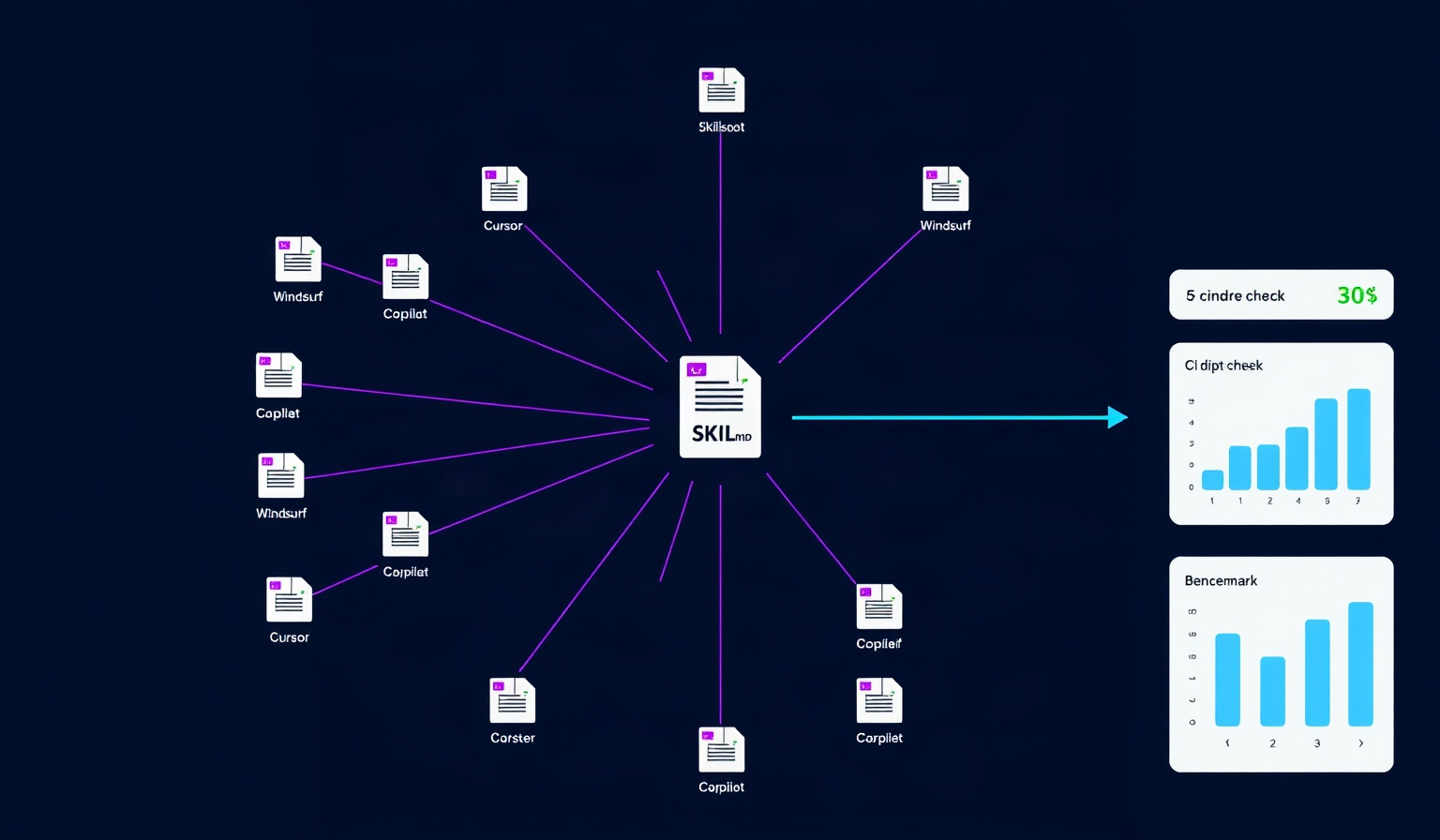
Ponytail’s architecture separates the canonical ruleset from host-specific adapters, with roughly 20 adapters covering Cursor, Windsurf, GitHub Copilot, and other environments agent-portability.md. The design distinguishes between plugin-tier integration (where the host supports external skill loading) and instruction-tier integration (where the ruleset must be injected into system prompts).
The drift-prevention mechanism is a consistency checker: check-rule-copies.js runs in CI and fails the build when mirrored copies drift from the canonical AGENTS.md check-rule-copies.js. The test suite validates that all seven mirrored rule copies remain aligned with the source of truth, catching staleness before users encounter divergent behavior.
This is the core engineering lesson: when you ship a prompt as a product, version control, diffing, and CI gates become prompt-management tooling. The prompt is code — it needs the same discipline. Teams adopting Ponytail inherit this pattern, whether or not they adopt the specific ruleset.
The tradeoff: every adapter adds maintenance surface. Each host’s prompt-injection quirks, token limits, and tool-calling behavior must be tracked. The repo’s issue tracker shows this cost is real — adapter-specific bugs appear regularly.
What Does the 7-Rung Ladder Actually Enforce?
The 7-rung ladder is a decision procedure applied after comprehension: need to exist? already here? stdlib? platform feature? installed dependency? one line? minimum that works — in that order, with the final rung being the minimum viable implementation that still solves the problem SKILL.md.
The ordering encodes a cost hierarchy. Existing code costs nothing. Standard library costs dependency overhead. Platform features cost compatibility risk. New dependencies cost supply-chain exposure. The ladder forces the agent to exhaust cheaper options before writing new code — and to stop at “minimum that works” rather than “minimum that’s elegant.”
The enforcement mechanism is a ponytail: debt-ledger marker that the agent appends when it intentionally skips a rung, creating an auditable trail of shortcuts SKILL.md. This is a clever design: rather than forbidding shortcuts, it makes them visible and reviewable.
Four intensity modes — lite, full, ultra, off — let teams tune how aggressively the ladder is applied per codebase SKILL.md. Ultra mode might reject a dependency that full mode tolerates. The modes are a pragmatic acknowledgment that not every codebase can absorb maximal laziness.
Do the Benchmark Numbers Survive Contact With Reality?
The corrected agentic benchmark reports −54% LOC, −22% tokens, −20% cost, and −27% time with 20/20 safe completions, from n=4 runs using Haiku 4.5 in headless Claude Code against a pinned FastAPI template agentic benchmark writeup. The controls matter: caveman terse-prose achieved −20% LOC but +7% tokens, while a bare 7-word YAGNI prompt got −33% LOC but only 19/20 safe.
The eval history is the more instructive story. The original 80–94% improvement claim was publicly debunked by Eberhardt, who demonstrated the benchmark methodology was flawed Eberhardt’s post. The maintainers rebuilt the benchmark in approximately 48 hours — and the rebuild immediately caught its own baseline-contamination bug, where the SessionStart hook fired on every arm, not just the treatment arm issue #126.
This is the eval-honesty arc worth studying: a public debunk, a rapid rebuild, and a self-caught bug in the new harness. The corrected numbers are more modest and more credible. The benchmark acknowledges its ceiling: “it never writes more… does not invent savings where there are none” agentic benchmark writeup.
| Dimension | Ponytail | Caveman (terse-prose) | Bare 7-word YAGNI prompt | hunk/herdr (guardrail tooling) |
|---|---|---|---|---|
| Form factor | ~100-line SKILL.md + ~20 adapters | Single instruction block | Single sentence | Toolchain integration |
| Core mechanism | 7-rung ladder + debt ledger | Terse imperative style | Minimal constraint | Post-hoc rule enforcement |
| Reported LOC effect | −54% | −20% | −33% | not reported |
| Reported token & cost effect | −22% tokens, −20% cost | +7% tokens | not reported | not reported |
| Safety record | 20/20 | not reported | 19/20 | not reported |
| Host coverage | ~20 adapters | none | none | toolchain |
| Drift protection | Consistency checks + CI tests | none | none | n/a |
| Eval & testability | Reproducible benchmark suite | none | none | n/a |
| Best-fit use case | Multi-harness teams | Single-host quick wins | Minimal intervention | Guardrail enforcement |
All benchmark figures from the agentic benchmark writeup; “not reported” indicates no published measurement. For more repo reviews and AI-engineering analysis, see the codeintel.xyz blog.
What Does Always-On Injection Really Cost?
Context injection carries a measurable tax: +6.9% cost in an A/B test (95% CI +3.9% to +10.0%, p<1e-4), with no break-even point identified issue #685. The injection adds ~11,158 characters (~2.8k tokens) once, but the resident re-read means ~17k cache-read tokens per turn.
The math: for a 10-turn task, that’s roughly 170k cache-read tokens and 28k billed input tokens per session. At typical pricing, the +6.9% overhead is the cost of discipline — but it’s not free, and it compounds with conversation length. The issue tracker notes open proposals (#664, #597) to reuse the ~670-token condensed fallback for short tasks where full injection is overkill.
The architectural question is whether injection should be always-on or adaptive. Always-on guarantees consistency but taxes every interaction. Adaptive injection saves tokens but risks the agent missing the ruleset when it matters. The current design optimizes for correctness; the cost is measurable and documented.
For teams running high-volume agent workloads, this overhead matters. A 6.9% cost increase across thousands of daily sessions is real money. The tradeoff is between paying the tax and accepting the risk of undisciplined agent output.
Where Does “Lazy” Stop Being Safe?
The safety exclusions are explicit: trust boundaries, data-loss handling, security, and accessibility are hard exclusions where the ladder does not apply SKILL.md. The benchmark’s 20/20 safety record came with these exclusions enforced — and the 19/20 result from the 7-word prompt shows what happens without them.
The ponytail: debt ledger is the key safety mechanism: it forces the agent to explicitly mark when it bypasses a rung, creating reviewable artifacts SKILL.md. This converts silent shortcuts into visible debt that humans can audit. The intensity modes (lite/full/ultra/off) let teams dial the aggressiveness per codebase.
The practical guidance: Ponytail’s safety record depends on the exclusions being enforced, not on the ladder itself. Teams adopting the ruleset must verify their harness respects the exclusion list. The benchmark’s 20/20 result is a property of the full system — ruleset plus exclusions plus harness — not the prompt alone.
What Breaks When a Prompt Becomes a Product?
The issue tracker documents real production friction. Windows users report hook latency of 31–39 seconds per invocation issue #763. The ruleset conflicts with host plan/review gates in some harnesses issue #757. Codex users report false-positive flags on legitimate code issue #764. macOS users hit Node-missing errors in the tooling issue #708.
The supply-chain risk materialized: a trojanized clone (0xwilliamortiz/ponytail-improved) distributed malware via DLL side-loading issue #735. This is the dark side of prompt-as-product: a prompt is easy to clone, and users may not verify provenance. The issue tracker’s response documents the takedown process and verification guidance.
These issues are not defects in the ruleset — they’re the cost of packaging a prompt as a distributable artifact. The prompt itself is trivial; the adapters, hooks, and tooling are where production complexity lives.
Is Ponytail Just YAGNI With Extra Steps?
Fundamentally yes, but the packaging changes the economics. YAGNI as an idea is free; YAGNI as a versioned, tested, drift-checked artifact is an engineering discipline. The 7-rung ladder operationalizes the principle into a decision procedure an agent can follow consistently SKILL.md. The debt ledger converts principle violations into auditable events. That’s the difference between a guideline and a system.
Does the +6.9% Injection Cost Matter at Scale?
At low volume, no — a few cents per session is noise. At scale — thousands of sessions daily — the overhead compounds. The 95% CI (+3.9% to +10.0%) means the true cost could be higher issue #685. Teams running high-volume agent workloads should measure their injection cost and consider the ~670-token condensed fallback proposed in #664 and #597.
Is It Safe to Adopt a Prompt With 113k Stars?
The star count is a popularity signal, not a safety certification. The benchmark’s 20/20 safety record is real but narrow — one template, one model, one harness agentic benchmark writeup. The malware-clone incident issue #735 shows popularity attracts bad actors. Verify you’re installing from the canonical repo, review the SKILL.md, and test against your own safety exclusions before deployment.
FAQ
These are the questions engineers most often ask after reading the review: licensing, harness support, and the token cost of always-on injection. Each answer cites the repository, its documentation, or the issue tracker, and none require running the project hands-on.
Is Ponytail free to use?
Yes. The repository is MIT-licensed, so the ruleset, adapters, and harness tooling can be used, modified, and redistributed freely GitHub repo.
Which agent harnesses does Ponytail support?
Roughly 20 adapters cover Cursor, Windsurf, GitHub Copilot, Claude Code, Codex, Gemini CLI, and more — plugin-tier where the host supports skills, instruction-tier via AGENTS.md elsewhere agent-portability.md.
What does always-on injection cost in tokens?
The injection adds roughly 2.8k tokens once, then about 17k cache-read tokens per turn; a measured A/B put the overhead at +6.9% cost with no break-even point issue #685.
The Bottom Line
Ponytail is worth studying as a prompt-as-product case study, not as a dependency. The discipline — versioned prompts, drift detection, honest evals, explicit safety exclusions — is the transferable value. Adopt the pattern, not the package: build your own ruleset with Ponytail’s engineering rigor, measure your own injection cost, and verify safety exclusions against your threat model.
📖 Related Reads
- ToolBrain — tool reviews, LLM comparisons, and AI workflow guides
- Hermes Tutorials — Hermes Agent setup, configuration, and advanced workflows
Cross-links automatically generated from CodeIntel Log.