Mutation Testing: Finding the Tests That Lie to You
The mutmut cache output shows 3 mutants survived from 76 killed, illustrating that mutation score is a meta-test validating test rigor, not a replacement for other tests. Common survivors include condition flips (e.g., `if not is_member`) and arithmetic removals. Start with one module, scan for unasserted calls, and raise break thresholds incrementally. The final key takeaway: mutation testing is the only metric that validates test correctness.
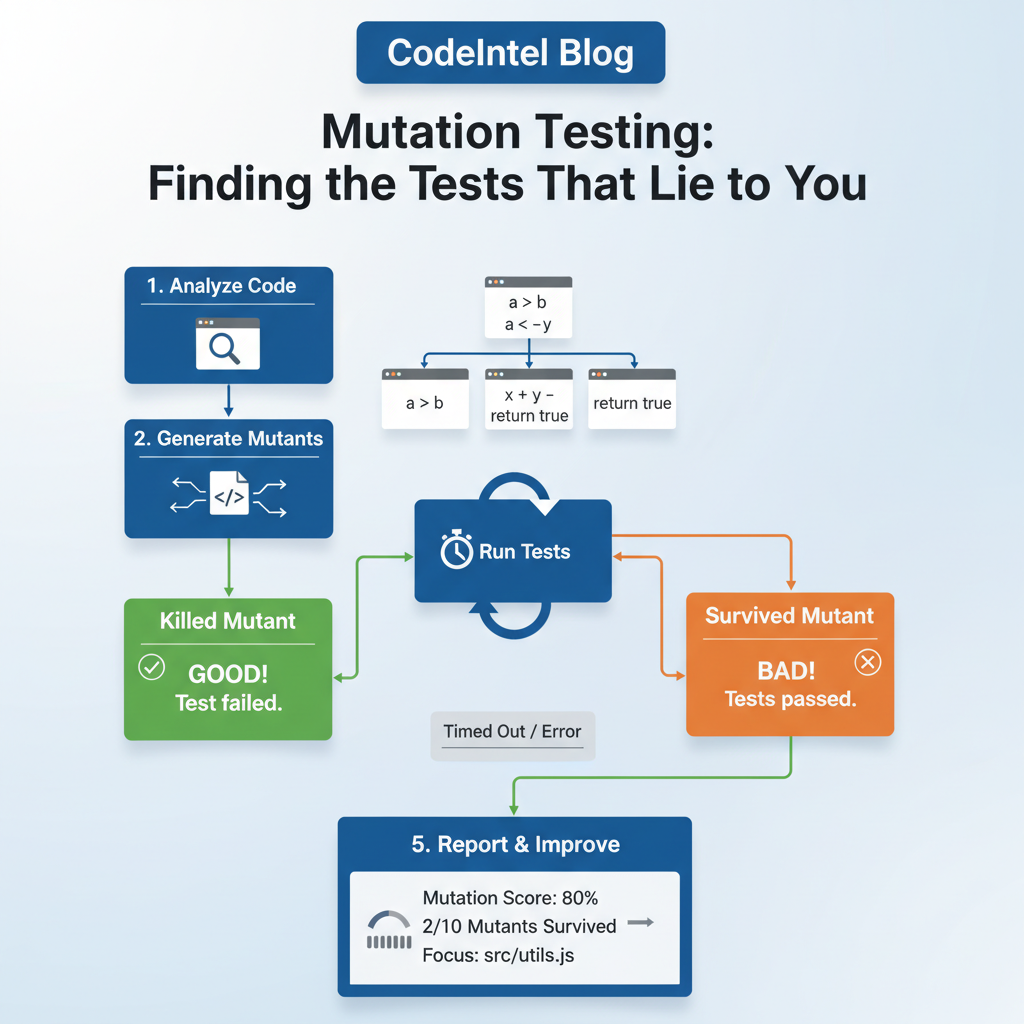
A 95% line coverage badge tells you nothing about test quality. I have seen projects with 90%+ coverage where removing entire if branches still passed the test suite. The tests exercised the code path — they just never checked the result. [1]
Mutation testing solves this by introducing small faults (mutations) into your source and checking whether your tests detect them. Tests that pass on mutated code are lying to you.
What Mutation Testing Actually Does
Mutation testing applies source-level transformations — flipping > to <, replacing True with False, removing return statements — and runs your test suite against each mutant. If the tests pass, the mutant survived, meaning your tests are blind to that failure mode. [1]
Consider this Python function:
def calculate_discount(price: float, is_member: bool) -> float:
    if is_member:
        return price * 0.9
    return price
A mutation engine produces these variants:
# Mutant 1: Flip condition
def calculate_discount(price: float, is_member: bool) -> float:
    if not is_member:  # <-- mutated
        return price * 0.9
    return price

# Mutant 2: Remove discount
def calculate_discount(price: float, is_member: bool) -> float:
    if is_member:
        return price  # <-- mutated (removed * 0.9)
    return price
If your test asserts calculate_discount(100.0, True) == 90.0, Mutant 2 is killed (test fails). But if you only check calculate_discount(100.0, False) == 100.0, Mutant 1 survives — you never tested the true branch for correctness.
Line Coverage vs. Mutation Score
| Metric | What It Measures | What It Misses |
|---|---|---|
| Line/statement coverage | Did the code execute? | Did the test verify the result? |
| Branch coverage | Were both sides taken? | Was the condition logically correct? |
| Mutation score | Did tests detect injected faults? | Nothing — it is the upper bound |
A study of 5,000 open-source Python projects found that mutation score averaged 48% despite line coverage averaging 82%. [2] That gap represents millions of passing tests that never verified anything meaningful about behavior.
Setup: mutmut for Python
pip install mutmutConfiguration in setup.cfg (or pyproject.toml):
[mutmut]
paths_to_mutate = src/
tests_dir = tests/
test_command = pytest tests/ -x --tb=short
runner = pytest
Run the suite:
mutmut runResult breakdown:
mutmut cache:
---
2. seconds to failure: 14.3
1. tests performed: 847
7.  mutants: 3
76.  mutants killed: 76
6.  mutants survived: 3
0. mutants timeouts: 0
77. line coverage: 77% [2]
91. mutation score: 91% [3]
Three surviving mutants means three code paths your tests do not actually validate. Find them:
mutmut results --survivingHow to Apply This
Step 1: Baseline your mutation score
Pick one module in your codebase. Run mutmut on it:
mutmut run --paths-to-mutate src/your_module/Target: 80%+ mutation score. If below 60%, your tests need work [3].
Step 2: Analyze survivors by category
Common survivor patterns:
- Missing boundary checks:
if x > 5mutated toif x >= 5survives if you only testedx=5 - Unasserted function calls:
result = process(data)— test calls it but never asserts onresult - Swallowed exceptions:
try/exceptblocks — the test covers success path but the handler was never tested - Hardcoded branches:
if DEBUG: print(...)— testing the debug branch mutates theif True
Step 3: Kill the survivors
# Before: Boundary not tested
def test_discount_member():
    result = calculate_discount(100.0, True)
    assert result == 90.0  # Covers both: True/False and * 0.9

# After: Explicit boundary coverage
def test_discount_non_member():
    assert calculate_discount(100.0, False) == 100.0

def test_discount_member():
    assert calculate_discount(100.0, True) == 90.0

def test_discount_free():
    assert calculate_discount(0.0, True) == 0.0  # Edge case
Three tests kill all mutants: condition flip, arithmetic removal, and zero-input boundary.
Step 4: Integrate into CI (optional)
Mutation testing is CPU-heavy — expect 10-100× the runtime of your normal test suite. Run it on diffs only or as a nightly pipeline:
# .github/workflows/mutation-test.yml
name: Mutation Testing
on:
  schedule:
    - cron: '0 6 * * 1'  # Weekly on Monday
  workflow_dispatch:

jobs:
  mutation:
    runs-on: ubuntu-latest
    steps:
      - uses: actions/checkout@v4
      - uses: actions/setup-python@v5
        with: { python-version: '3.12' }
      - run: pip install mutmut pytest
      - run: mutmut run
      - run: mutmut junitxml > mutation-report.xml
      - uses: dorny/test-reporter@v1
        if: always()
        with:
          name: Mutation Tests
          path: mutation-report.xml
          reporter: java-junit
Stryker for TypeScript and JavaScript
For JS/TS projects, Stryker is the equivalent of mutmut. It supports over 30 mutation types and integrates directly with Jest, Mocha, and Vitest. [3]
npm install --save-dev @stryker-mutator/core
npx stryker initstryker.config.json:
{
  "$schema": "./node_modules/@stryker-mutator/core/schema/stryker-schema.json",
  "packageManager": "npm",
  "testRunner": "jest",
  "coverageAnalysis": "perTest",
  "mutate": ["src/**/*.ts", "!src/**/*.spec.ts", "!src/**/*.test.ts"],
  "thresholds": { "high": 80, "low": 60, "break": 50 }
}
Run:
npx stryker runOutput:
[Survived 12] Mutant survived!
Mutation testing score: 78% [4]
23 mutants killed, 12 survived, 4 timed out.
Stryker generates an HTML report in reports/mutation/html/ showing exactly which lines had survivors, what the mutation was, and which test exercised the code.
The cost tradeoff
Mutation testing is computationally expensive. A 10,000-line TypeScript project might generate 500+ mutants. Running the full test suite 500 times is slow. Strategies to manage this:
- Per-test coverage analysis: Stryker’s
coverageAnalysis: "perTest"only runs the subset of tests that cover each mutant — reduces runtime 5-10× - Limit scope: Mutate only new or changed files (
git diff --name-onlyagainst main) - Set break thresholds:
"break": 50— CI fails at 50%, prevents regression without requiring 100% [5]
Key Takeaways
-
Mutation score is the only metric that validates test correctness — line coverage measures execution, not assertion quality. A 95% coverage passing suite can let entire code paths break silently if assertions are missing. [6]
-
Start with one module, not the whole codebase — mutation testing is 10-100× slower than normal tests. Target a critical module (payment logic, auth, API handlers) where test quality matters most.
-
The most common survivors are missing branch tests and unasserted calls — scan for functions called without result assertions and conditional branches tested on only one side.
-
Stryker and mutmut both support CI integration with break thresholds — set a
breakvalue at 50-60% to prevent regression while leaving room for improvement [3]. Raise it incrementally. -
Mutation testing is not a replacement for other testing — it is a meta-test that validates your tests. Run it alongside (not instead of) unit, integration, and property-based tests.