The Agent Service Mesh: Production Patterns for Inter-Agent Communication and Governance
Just as service meshes solved microservice-to-microservice communication at scale, agent meshes solve agent-to-agent communication. This essay examines the A2A protocol, Microsoft's Agent Governance Toolkit, and the architectural patterns for production inter-agent infrastructure.
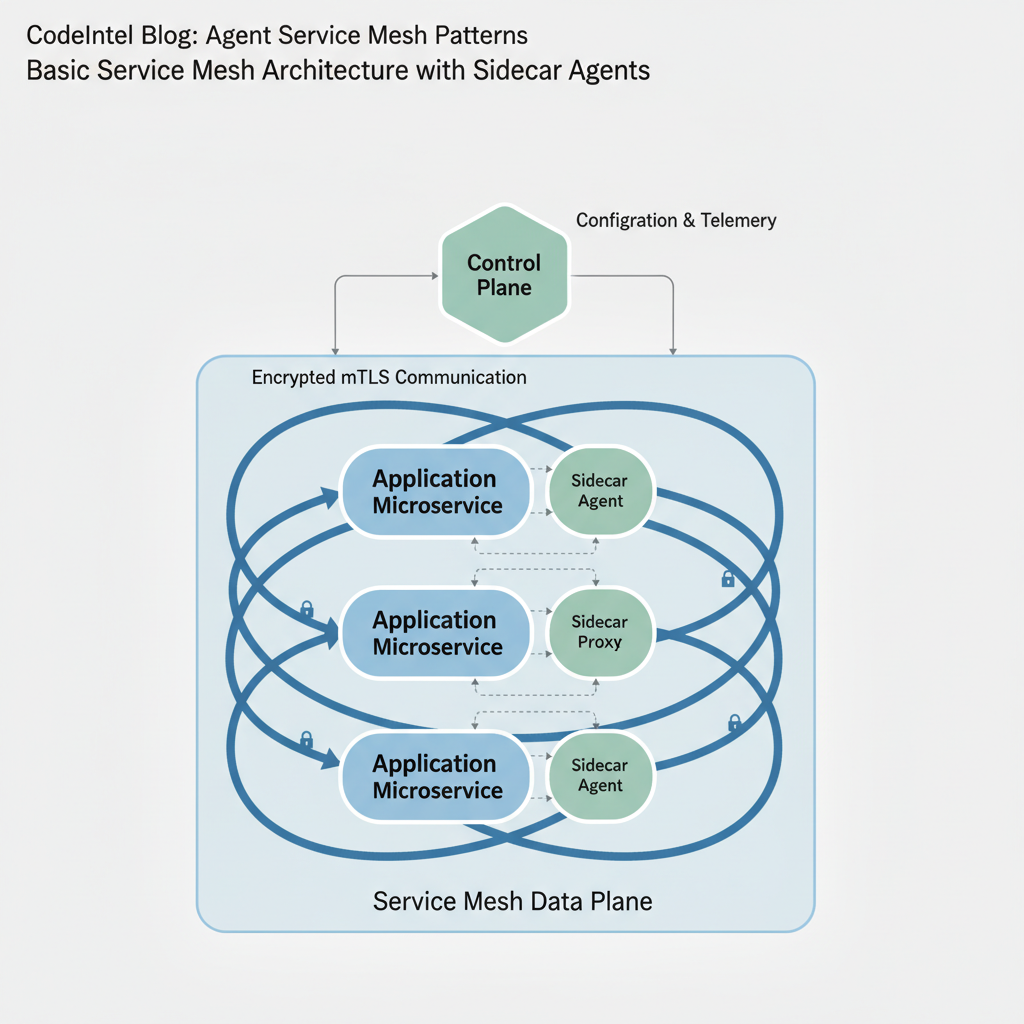
The parallel is striking. In 2017, Istio and Linkerd solved the problem of microservice-to-microservice communication — observability, security, traffic management — without changing application code. By 2026, the same pattern is repeating for AI agents.
Two standards have emerged as the backbone: Google’s Agent2Agent (A2A) Protocol at the transport layer, and Microsoft’s Agent Governance Toolkit at the policy/identity layer. Together they form what practitioners are calling the Agent Service Mesh — infrastructure that makes inter-agent communication observable, secure, and governable without invading agent internals.
Why agents need a mesh, not point-to-point wiring
A naive multi-agent system connects agents via direct API calls. Agent A knows Agent B’s endpoint, calls it with a JSON payload, and hopes for the best. This works for two agents. It breaks at ten.
The failure modes are identical to pre-meshed microservices:
| Problem | Microservice (2016) | Agent (2026) |
|---|---|---|
| Service discovery | Hardcoded IPs | Hardcoded agent URLs |
| Auth | Per-service tokens | Per-agent API keys |
| Retry/timeout | Hand-rolled | Hand-rolled |
| Observability | Scattered logging | Scattered logging |
| Circuit breaking | None | None |
| Policy enforcement | None | None |
The service mesh solved this by inserting a sidecar proxy that handles all cross-cutting concerns. The agent mesh applies the same principle: a protocol layer + policy layer that every agent connects through, not point-to-point.
A2A: the transport protocol
The A2A Protocol, now at v1.0.1 (May 28, 2026) under the Linux Foundation, defines how agents discover, negotiate, and communicate [1]. Its architecture has three key properties:
Agent Cards for discovery. Every agent publishes an AgentCard — a JSON document describing its capabilities, supported interaction modes (text, forms, streaming), and authentication requirements. Clients discover agents via these cards without knowing internal implementation details.
JSON-RPC 2.0 transport. All messages use JSON-RPC 2.0 over HTTP(S), with optional SSE for streaming and gRPC for high-throughput scenarios [2]. The protocol is transport-agnostic in the spec; bindings are defined separately for JSON-RPC, gRPC, and HTTP/REST.
Opaque agent boundaries. A2A agents never expose internal state, memory, or tools. They collaborate through a task-oriented interface: “here’s a task, here’s the context, give me a result.” This preserves security boundaries and IP protection — a critical design choice that distinguishes A2A from earlier agent-interop attempts that required shared memory.
The ecosystem now spans 150+ organizations including Adobe, ServiceNow, S&P Global, and Twilio — the latter implementing a Latency Aware Agent Selection extension that broadcasts agent latency metrics and routes to the most responsive peer [1].
Agent Governance Toolkit: the policy and identity layer
A2A solves how agents talk. Microsoft’s Agent Governance Toolkit (v3.0, April 2026) solves what they’re allowed to do [3]. It’s a 9-package monorepo that functions as the policy sidecar for the agent mesh:
from agent_os import StatelessKernel, ExecutionContext, Policy

kernel = StatelessKernel()

ctx = ExecutionContext(
    agent_id="analyst-1",
    policies=[
        Policy.read_only(),                    # No write operations
        Policy.rate_limit(100, "1m"),          # Max 100 calls/minute
        Policy.require_approval(
            actions=["delete_*", "write_production_*"],
            min_approvals=2,
            approval_timeout_minutes=30,
        ),
    ],
)

result = await kernel.execute(
    action="delete_user_record",
    params={"user_id": 12345},
    context=ctx,
)
Three patterns are worth extracting:
Stateless policy kernel. The Agent OS component intercepts every tool call before execution, running it through a two-layer filter: configurable pattern matching (SQL injection, privilege escalation, prompt injection) and a semantic intent classifier that detects dangerous goals regardless of phrasing [3]. The kernel is stateless — deployable behind a load balancer, as a Kubernetes sidecar, or in a serverless function.
Decentralized identity with trust decay. Agent Mesh assigns each agent a Decentralized Identifier (DID) with Ed25519 signing. Agents carry a trust score (0-1000) that decays over time without positive signals. A TrustBridge verifies peer identities before allowing communication:
from agentmesh import AgentIdentity, TrustBridge

identity = AgentIdentity.create(
    name="data-analyst",
    sponsor="[email protected]",
    capabilities=["read:data", "write:reports"],
)

bridge = TrustBridge()
verification = await bridge.verify_peer(
    peer_id="did:mesh:other-agent",
    required_trust_score=700,
)
Execution rings (CPU privilege model). Agents operate in one of four rings inspired by CPU privilege levels:
| Ring | Trust Score | Capabilities |
|---|---|---|
| Ring 0 (Kernel) | ≥ 900 | Full system access, can modify policies |
| Ring 1 (Supervisor) | ≥ 700 | Cross-agent coordination, elevated tools |
| Ring 2 (User) | ≥ 400 | Standard tools within assigned scope |
| Ring 3 (Untrusted) | < 400 | Read-only, sandboxed execution |
New agents start in Ring 3 and earn their way up — least privilege by default. Each ring enforces per-call resource limits: execution time, memory, CPU, request rate.
The Agent Service Mesh architecture
Combine A2A + Agent Governance Toolkit and you get a clear three-layer architecture:
┌──────────────────────────────────────────┐
│          Orchestration Layer             │
│  Task routing · priority · escalations   │
├──────────────────────────────────────────┤
│          Protocol Layer (A2A)            │
│  Agent Cards · JSON-RPC · gRPC · SSE     │
├──────────────────────────────────────────┤
│          Policy Layer (Governance)       │
│  DID identity · policy kernel · rings    │
├──────────────────────────────────────────┤
│          Agent Layer                     │
│  Specialized agents (analyst, coder,     │
│  researcher, customer support)           │
└──────────────────────────────────────────┘
Each layer handles a distinct concern:
- Agent layer — domain-specific agents that do actual work (research, coding, customer support). Opaque to other layers.
- Policy layer — intercepts every incoming and outgoing call. Enforces identity verification, rate limits, approval workflows, and ring-based access. Runs as a sidecar or gateway.
- Protocol layer — handles discovery (Agent Cards), transport (JSON-RPC/gRPC), streaming (SSE), and task lifecycle. Standardizes how agents find and talk to each other.
- Orchestration layer — routes tasks to appropriate agents, manages failure handling, and coordinates multi-step workflows.
A request flows through all four layers:
Agent A → Policy Sidecar → A2A Gateway → Policy Sidecar → Agent BThe policy sidecars enforce both caller and callee policies. Agent A’s sidecar checks: “can A talk to this endpoint?” Agent B’s sidecar checks: “should B accept tasks from A?” This double-enforcement prevents either side from being exploited.
Practical deployment patterns
Pattern 1: Sidecar per agent (Kubernetes). Every agent pod runs a sidecar container with agent-os (policy) and an A2A listener. Agents communicate through the sidecar via localhost. The sidecar handles all mesh traffic. Same pattern as Istio’s Envoy sidecar injection.
Pattern 2: Central gateway (serverless). For agent deployments on Cloud Run or serverless, deploy an A2A gateway as a reverse proxy. All inter-agent traffic routes through it. The gateway terminates A2A connections, applies policy, and forwards to agents via internal HTTP. This is Google’s recommended deployment for A2A on Cloud Run [1].
Pattern 3: Hybrid with ingress/egress gateways. Multi-cluster or multi-cloud setups use ingress gateways (inbound A2A traffic) and egress gateways (outbound A2A traffic). Agents inside a cluster communicate via sidecars; cross-cluster traffic traverses gateways. Same pattern as Istio’s ingress/egress gateway architecture.
What’s missing
The agent service mesh is nascent. Three gaps remain:
-
No standard Agent Card registry. A2A defines the card format but not where cards live. Service meshes solved this with control planes (Istiod, Linkerd control plane). Agent meshes need equivalent registry infrastructure.
-
Policy composition across trust boundaries. When Agent A (Ring 3) calls Agent B (Ring 2) which calls Agent C (Ring 0), whose policy wins? The Governance Toolkit has scope narrowing (child inherits parent’s restricted scope) but no documented semantics for conflict resolution across independently-managed agents.
-
No error budget / SLO framework yet. The Governance Toolkit’s
Agent SREpackage defines SLOs and circuit breakers [3], but A2A has no equivalent. Cross-agent SLOs — “Agent A must respond within 2s or the mesh degrades gracefully” — aren’t part of either spec.
Key takeaways
-
The agent mesh is the service mesh of AI agents. A2A provides the transport standard; the Agent Governance Toolkit provides the policy and identity layer. Together they form production-grade inter-agent infrastructure.
-
Opaque agent boundaries are the right abstraction. Agents expose capabilities (Agent Cards), not internals. This preserves security and lets teams evolve agents independently.
-
Double-enforcement policy is non-negotiable. Both caller and callee run policy sidecars. A single enforcement point creates a security bottleneck.
-
Start with 2-3 agents and an A2A gateway. Don’t build the full mesh day one. Deploy agents behind a central A2A gateway, add policy enforcement, then expand incrementally.
The same forces that drove microservices to adopt sidecar proxies are driving multi-agent systems toward mesh architectures. The difference this time: we have the protocol and policy standards before the ecosystem hits peak fragmentation, not after.
References
[1] Rao Surapaneni, Philip Stephens, “Agent2Agent Protocol (A2A) is getting an upgrade,” Google Cloud Blog, July 2025. https://cloud.google.com/blog/products/ai-machine-learning/agent2agent-protocol-is-getting-an-upgrade
[2] A2A Protocol specification v1.0.1, Linux Foundation / a2aproject, May 2026. https://github.com/a2aproject/A2A
[3] mosiddi (Microsoft), “Agent Governance Toolkit: Architecture Deep Dive, Policy Engines, Trust, and SRE for AI Agents,” Microsoft Community Hub, April 2026. https://techcommunity.microsoft.com/blog/linuxandopensourceblog/agent-governance-toolkit-architecture-deep-dive-policy-engines-trust-and-sre-for/4510105
[4] “The Agentic Mesh: Enterprise Architecture for Autonomous AI in 2026,” Extency Blog, March 2026. https://extency.com/blog/agentic-mesh-enterprise-architecture-2026